We are off on Friday to the SF Bay area to celebrate the 100th anniversary of Linda's church, to visit her cousins, to visit her brother, and to visit our daughter's family, including celebrating Lucas' 3rd birthday. This is a driving vacation - up I-5 and US 101. We should be home on Monday, 18 September.
I will be checking my email, and will have access to a computer on some days, so I will read my favorite blogs on a regular basis. I may post here if something interesting or special catches my eye.
I have posted a lot of jokes (from my email correspondents) and some family pictures on my other blog at http://randysbusylife.blogspot.com. It seems I am way too busy posting on this genealogy blog to post about daily life things there. Oh well.
While I'm gone, please sample the news, thoughts and opinions posted by my fellow genea-bloggers - many of whom are listed on the blogroll on the right side of this page.
Thursday, September 7, 2006

Using the Reference USA database
I was checking my local library databasel ist, and saw the Reference USA database - which is a research and reference tool available to library users. It has 14 million business listings and 120 million US household listings. I had to use my library card number to access it.
This database can be used to find:
1) People by surname, given name or middle initial
2) People by phone number or area code
3) People by address, zip code, county, state, etc.
4) Any combination of the above.
You select the search criteria, click on "Create Search Form" and then fill in the blanks of the search form.
Using this database, you can find out who lives at a specific address in a specific zip code or county - handy if you need to call somebody but you've forgotten how their name is spelled or just wonder who lives at the address now. I looked for the address of the house I grew up in - and found the name and phone number of the residents.
You can also get a listing of a given surname in a state, county or zip code. This is useful if you know the state and surname, but don't know the address or phone number.
They even have an option to find the median household income and median housing price - but this appears to be for a given zip code or census district. The housing values seem low for my area. This option also gives you latitude and longitude of the house.
I don't know how up to date it is - but it covered my brother's move in early 2005.
All in all, it's a pretty good database without all of the advertisements that you find on other commercial sites. You can purchase the lists if you choose to from Reference USA.
Check your local library databases - you may be surprised what you can find.
Presenting ... the real Annie Moore
I was on vacation when Megan Smolenyak Smolenyak revealed that the real Annie Moore (the first immigrant through Ellis Island) had been discovered, so didn't blog about it at that time.
Megan has now revealed that there will be a program at the New York Genealogical and Biographical Society meeting on 15 September to discuss the findings and award the $1,000 prize to two recipients. Megan's latest post is here.
The press release announcing the event includes:
I look forward to reading more about the actual search and what the family has to say. Hopefully, Megan will blog about it after 9/15 for those of us who can't make it to New York. Even better, an online Podcast and slide presentation would be great!
Megan has now revealed that there will be a program at the New York Genealogical and Biographical Society meeting on 15 September to discuss the findings and award the $1,000 prize to two recipients. Megan's latest post is here.
The press release announcing the event includes:
Truthiness Invades Our Shores: The Real Story of the First Ellis Island Immigrant
Note: Announcement to be made at 3:00 p.m. on September 15, 2006 at The New York Genealogical & Biographical Society, 122 East 58th Street, New York, NY 10022-1939.
NEW YORK, September 6, 2006 -- It’s a classic case of truthiness. For years, we’ve chosen to believe an oft-told myth about Ellis Island when the truth was readily available. But on September 15th, that will change.
13-year-old Annie Moore was the first immigrant to enter our country via Ellis Island. She tripped down the gangplank on January 1, 1892 along with a pair of younger brothers, and was greeted with much fanfare. Officials welcomed her arrival and presented her with a $10 gold coin in commemoration of the special event.
Her statue stands both at Ellis Island and the Cobh Heritage Centre, the Irish emigration counterpart in Co. Cork. Everything from Irish-American cultural awards to pubs has been named after her, but she remained a mystery until the 1990s when Ellis Island was refurbished and opened to the public. Then we learned what happened to Annie after Ellis Island -- how she ventured to New Mexico, married a descendant of an Irish patriot, had a handful of children, was widowed, became a businesswoman, and died in an accident.
It was a terrific go-West-young-woman tale tinged with tragedy. Just one problem. It was wrong.
40 percent of all Americans have at least one ancestor who entered the country via Ellis Island, and in the midst of our current immigration debate, politicians allude to their Ellis Island roots on a daily basis. It’s part of the fabric of American history and who we are as a people – and yet, we’ve got the wrong Annie.
That irked genealogist Megan Smolenyak Smolenyak (her real name) when she accidentally discovered that the much-touted Annie was actually born in Illinois. Determined to learn the truth, she launched an online contest with a $1,000 prize for the first proof of what became of the right Annie. It took only six weeks and an eager gang of amateur, history-mystery detectives to uncover the real story.
The true story will be shared by Smolenyak, Brian G. Andersson (Commissioner, NYC Department of Records), and family members of the real Ellis Island Annie at 3:00 p.m. on September 15, 2006 at The New York Genealogical & Biographical Society.
Contact:
Merry Brickley
949-235-3171
AnnieMoore1892@aol.com
I look forward to reading more about the actual search and what the family has to say. Hopefully, Megan will blog about it after 9/15 for those of us who can't make it to New York. Even better, an online Podcast and slide presentation would be great!
Wednesday, September 6, 2006
Genealogy book writing and publishing
I missed the last carnival of genealogy, about writing family history books, due to my vacation, but I wanted to share my experiences.
I have written and self-published two family history books so far, but I've distributed them only to my family members. As far as I can tell, they sit on their shelves gathering dust or are used as paperweights. I suggested to my family that they should keep them handy since they are real effective insonmia cures.
The first book was the ancestry of my mother in an ahnentafel report format in 1994, about 170 pages. While I was using PAF 2 at the time, I typed it into Microsoft Works by hand - names, dates, places, spouses, kids, and narrative text notes. I also included some photos and document images made from xerox copies of originals. While it was a chore, it gave me the incentive to not do it again. All was not lost, since I was able to copy and paste the text notes from the document into my PAF notes file. I published this using xerox copies, a card stock cover and a comb binding at the local copy store.
The second book was the ancestry of my third-great grandfather, Benjamin Seaver (1791-1825), in a multi-family report format in 2001, about 210 pages. I included an ahnentafel list for Benjamin Seaver so the readers could determine how everybody was related. I also included a report on the descendants of Benjamin Seaver through my father's generation, so the reader could figure out the Seaver line after Benjamin. For this book, I used the report generation capability in FamilyTreeMaker for each family line. I followed each family line from the immigrant ancestor down to the daughter who married into another family. I collected each family line report and put them in surname alphabetical order in the book, which I wrote and edited in Microsoft Word. I published this using xerox copies, a soft cover and a comb binding at the local copy store.
The challenge of both books was to get the text notes in a consistent form - I chose a narrative form that was essentially in a timeline. I transcribed wills in their entirety and abstracted deeds, other probate records, town records, military records, etc.
I cited my sources within the text notes since I had not figured out how to use the source citation in FTM effectively. I had to edit many items since the text notes do not render columns of numbers well into MSWord. I also found many typos in my text notes in FTM.
My master plan had been to write a series of books for five lines of my father's ancestry:
1) Ancestors of Benjamin Seaver (1791-1825)
2) Ancestors of Abigail Gates (1797-1867), wife of Benjamin Seaver
3) Ancestors of Lucretia Townsend Smith (1827-1884), wife of Isaac Seaver
4) Ancestors of Hattie Hildreth (1857-1922), wife of Frank W. Seaver
5) Ancestors of Alma Bessie Richmond (1882-1962), wife of Frederick W. Seaver
The last four books are the spouses of my Seaver ancestors since Benjamin Seaver. I chose to do this for two reasons:
1) It broke the research up into blocks of research and data - I could concentrate on a number of specific families - usually 40 to 50.
2) The books would be between 150 and 250 pages in size, and I could complete each one in turn easier than doing a 1,000 page tome many years from now.
I have not completed the research on the other four books. I'm bogged down at about 1725 in Middlesex MA land records, and have not done much in Suffolk or Bristol County MA records, nor Rhode Island records. I have a pile of about 1000 abstracted deeds from Middlesex County MA to enter into the database. It looks like a full time job to me, and isn't too exciting, either! I'd rather do research and write than slog through it day in and day out.
I did not create an index for either book, because of the lack of free indexing programs (I'm still cheap!) and the indexing limitations in FamilyTreeMaker. I have looked at the GenBook program (and bought an early version years ago) and it looks like it will create the index codes for MSWord, but I haven't used it yet.
Your comments are welcome - how have you written a book, what standards did you use, and how did you index it?
Find your ancestor's home in 19th century
Dick Eastman blogged about the Historic Map Works web site several weeks ago, and I just got around to looking at it.
They have historic maps that show the owners of homes in some towns and counties in Delaware, Texas, Maine, New Hampshire, Vermont, Connecticut, Rhode Island, New York and Pennsylvania. Maine and New York seem to have the most, and most of those are for 1876. Still, it is a good resource if they cover your town or county of interest. They also have City Directories for some New York and Maine cities.
To find out if they have a map for your ancestral home, you can click on the "Browse Map" button. Then click on one of the states and you will get a list of the maps available.
I was interested in Newton families in Oxford County ME, and they have an 1880 map that shows 33 plates, including Andover and dixfield (probably my ancestral towns). The Dixfield map shows Newton Brook running past H. Newton's house - we were just nearby there last Thursday!. The Andover map shows several Newton households.
You can magnify the map by clicking on the + symbol, and you can move around on the map using the up, down, right, and left arrows.
Be sure to note the neighbors of your ancestors too - that info can be vital to determine if you have the right people in census or deed records.
While the offerings are limited now, it's worth a try! When they have more maps available, this will be a great research site.
Tuesday, September 5, 2006
Carnival of Genealogy - 7th Edition is available
The 7th Edition of the Carnival of Genealogy is available at Jasia's Creative Gene blog here. Jasia hosts the carnival twice a month on her blog, and she compiles it, and always does an excellent job.
What is a carnival of genealogy, you ask (again?). It's a collection of blog posts or online articles about a specific genealogy or family history subject. The theme of the 7th edition is "Writing a Family History." Please go read the whole article.
I was going to submit a blog post for this theme, but was on vacation. I may write about my book-writing experiences in a later blog post.
The deadline for the 8th Edition of the Carnival of Genealogy is September 18, and the theme is "Family Photos." Blog about the topic and submit your post to Jasia for inclusion in the Carnival. To submit your post, click on the link to the submittal form here and fill out the requested information.
Catalog your books on LibraryThing
This is not new information to some astute genealogy bloggers and readers, but is new to me. Birdie Monk Holsclaw, CG, has an article in the July/August/September 2006 issue of the NGS NewsMagazine. Jasia blogged about it here, and provides a link to see her own book holdings. You can see the different display options by clicking around Jasia's site.
LibraryThing.com is a web site that allows you to catalog the books that you own, and even allows you to make a wish list for your friends and relatives can buy you a gift. The web page includes:
I haven't done this yet, but will do it soon. I'll share the URL on my blog when I do it.
LibraryThing.com is a web site that allows you to catalog the books that you own, and even allows you to make a wish list for your friends and relatives can buy you a gift. The web page includes:
Enter what you're reading or your whole library — it's an easy, library-quality catalog. Because everyone else is doing it too, LibraryThing connects you with people who read the same things.
What's good?
* Searches Amazon, the Library of Congress and 45 other world libraries.
* Show it or keep it private. Put your books on your blog too.
* Get recommendations. Connect to people with all your obscure stuff.
* Tag your books as on Del.icio.us and Flickr (eg., wwii, magical realism, vampires, theology, dogs, philosophy of science).
* Export your data. Import from almost anywhere too.
* Enter 200 books for free, as many as you like for $10 (year) or $25 (life).
I haven't done this yet, but will do it soon. I'll share the URL on my blog when I do it.
Some of my ancestral homes
One of my goals for my recent trip to New England was to photograph as many of my known ancestral homes as possible. I only know of a few ancestral home sites for sure - but am gradually collecting the maps and records needed to identify the sites for other ancestors. What I've included here are the "low hanging fruit" - the ones I've known about for awhile.
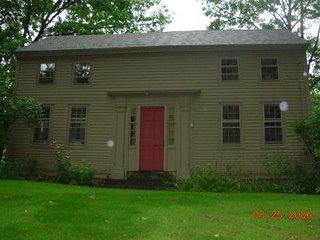
The oldest Seaver ancestral home is in Westminster MA - Norman Seaver built a salt-box type house in the 1770's. At least three generations of my Seaver line lived in this house - Norman, Benjamin and Benjamin. Job Seaver, the brother of the first Benjamin was a bachelor and lived there until his death in the 1870's. The house is on Overlook Road in north Westminster, and is in the Westminster book about old houses.
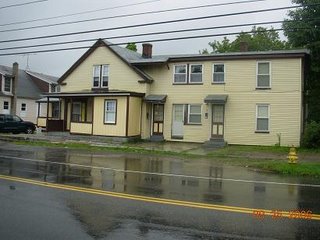
Another ancestral home is in Leominster at 149 Lancaster Street. My great-great grandparents, Edward and Sophia (Newton) Hildreth) resided here from about 1890 to 1923, and my great-grandparents Frank and Hattie (Hildreth) Seaver resided here from before 1890 to their deaths. My grandparents, Fred and Bess (Richmond) Seaver lived in this house for several years after their marriage in 1900. Compared to a picture taken about 1907, this house has been remodeled extensively - perhaps because the road is much closer to the house now!
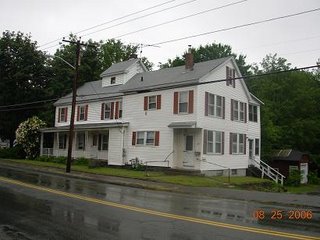
The Fred and Bess (Richmond) Seaver family moved to Fitchburg before 1905, and then moved into 290 Central Street in Leominster after 1911, and resided there until about 1927. This is the house that my father and his siblings remember. The hopuse looks pretty much like they remember it.
There are still many more ancestral homes to find and photograph. I'm going to make a list of ancestral home sites and try to find them next time I visit New England.
The oldest Seaver ancestral home is in Westminster MA - Norman Seaver built a salt-box type house in the 1770's. At least three generations of my Seaver line lived in this house - Norman, Benjamin and Benjamin. Job Seaver, the brother of the first Benjamin was a bachelor and lived there until his death in the 1870's. The house is on Overlook Road in north Westminster, and is in the Westminster book about old houses.

Another ancestral home is in Leominster at 149 Lancaster Street. My great-great grandparents, Edward and Sophia (Newton) Hildreth) resided here from about 1890 to 1923, and my great-grandparents Frank and Hattie (Hildreth) Seaver resided here from before 1890 to their deaths. My grandparents, Fred and Bess (Richmond) Seaver lived in this house for several years after their marriage in 1900. Compared to a picture taken about 1907, this house has been remodeled extensively - perhaps because the road is much closer to the house now!

The Fred and Bess (Richmond) Seaver family moved to Fitchburg before 1905, and then moved into 290 Central Street in Leominster after 1911, and resided there until about 1927. This is the house that my father and his siblings remember. The hopuse looks pretty much like they remember it.

There are still many more ancestral homes to find and photograph. I'm going to make a list of ancestral home sites and try to find them next time I visit New England.
Things I Love About New England
I love that I have New England ancestry - and love the parents, grandparents and earlier generations that made it possible. I love my aunts, uncles and cousins, and all of their families, who still live there - so we can visit them often!
I love the town, county and state records of New England - the births, deaths, marriages, deeds, probates, taxes, town proceedings, cemeteries, and other records. On the one hand, genealogy research is made easier by these records. However, the sheer volume of records is mind-boggling, and makes research a full-time career.
I love the small towns of New England - in most cases, there is a small central core with several main streets, with some feeder streets and many side streets. Outside of the central core, the houses and farms are spaced out, and many of them have woods, streams, ponds, and other natural features.
I love the roads of New England. The freeways and tollways are adequate, except around Boston. The US highway and state roads allow you to go 40 to 60 miles per hour over long stretches, punctuated by small town centers. The roads and streets in town are rarely in a grid, which makes it harder to get around. The round-abouts work well.
I love the houses of New England - they have character, and are generally pretty large. The colonial and Victorian houses are interesting, inside and out. They usually have cellars or basements, and separate garages.
I love the churches of New England - some are modern, but most are 18th or 19th century, many were formerly Congregational churches. They are a central feature of the small town centers. Some are built of stone, others of wood. The steeples are majestic.
I love the graveyards of New England - in most cases, the oldest ones are near the town centers. The oldest stones are often of the "potato chip" style made of slate, and later ones are granite. Walking through the stones gives me chills - I often talk to them, and wonder what kind of life these people had.
I love the stone walls of New England - they set off property and are decorative. No two are alike. There are still plenty of stones in the ground, too.
I love the helpful and friendly people of New England - at least the ones we meet in the small towns we visit - in the libraries, hotels, restaurants and attractions we patronize.
What have I missed about New England? Tell me so I can experience them.
Monday, September 4, 2006
A Birthday Calculator
One of my email friends sent along this link to a Birthday Calculator.
At this site, you input your birth date and get a list of information that tells you a number of calendar facts, (including your age in days, hours, minutes, seconds), astrological data, life path type and compatibility, people who share your birthday, top songs in your birth year, and more.
At a minimum, it's a good conversation starter, and can be helpful to genealogists wanting to know exactly how old they are.
Subscribe to:
Posts (Atom)