Showing posts with label Steve Morse. Show all posts

Wednesday, March 16, 2022

Rabbit Holes With Randy - Preparing for the 1950 U.S. Census

 This week's Rabbit Hole exercise was to find the Enumeration Districts (EDs) for my close family members in 1950, as preparation for the release of the 1950 census on 1 April 2022.  Hopefully, we can find every family member during the first week of access, whether the NARA indexing effort works or not.  

This will be the first census that I am in, so I am excited to see what my entry, as a 6 year old, looks like.  I consider "close family members" to be parents, siblings, grandparents, great-grandparents, aunts, uncles, first or second cousins, etc.  I'm looking for my wife's close relatives too.  Because my mother had no siblings, and her parents had no siblings, I have very few close relatives on her side - just my grandparents and one great-grandparent.  I do have 3rd or 4th cousins on her side of my ancestry, so I may include some of them at a later date.  I do have aunts, uncles and first and second cousins on my father's side.  I need to include my wife's aunts and uncles also.  

My process for finding the Enumeration Districts was pretty simple:

*  Used the City Directories collection on Ancestry.com to find the addresses for my target people. Almost all of them had street addresses.

*  Used Google Maps to find the address in the current map, and identified the cross streets for the block with the target address.  

*  Then I used the Steve Morse website Unified Census ED Finder (https://stevemorse.org/census/unified.html) for 1950 to identify the Enumeration district for each person on my list.  

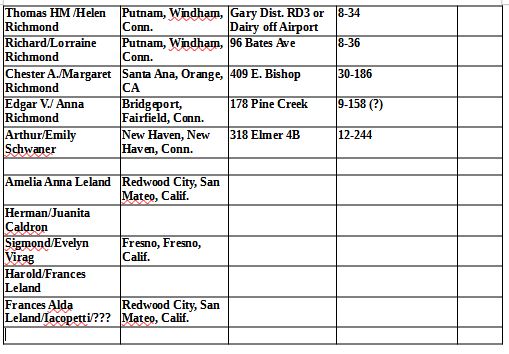
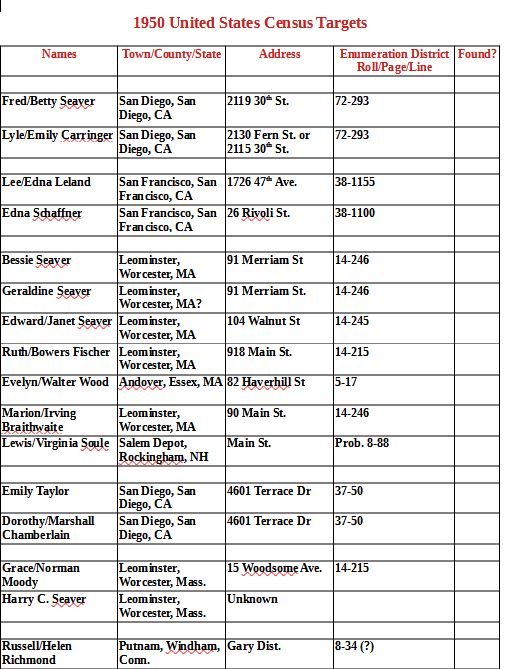
*  Put all of that information on a word processor table so that I can print it out and write on it as I find the people in the Census.  I will write down the Roll number, Page number and Line numbers for each target entry so I can find them again.  

Here is my current list of names, addresses, and ED numbers:


Finally, I will enter the Event into my RootsMagic family tree along with a family summary in a Note and a source citation, plus an image of the census page.  I will probably write blog posts detailing what I find, especially the entry for my birth family (I sure hope they - and me - were not missed!).  It will be interesting to see who the neighbors are around my home.

I think I'm ready...I am still finding cousins to add to my list, but by 1 April I should be all set.  The biggest question I have is "will all of my relatives be enumerated?"  In the 1940 U.S. census, my grandmother, Alma Bessie (Richmond) Seaver (1882-1962), was not enumerated, but my grandfather was!

Of course, the NARA index to the 1950 U.S. Census may work like a charm, and the website may work quickly, and the links to specific pages will be accurate, and all of the ED preparation might be for naught.  We will see!  I am ready in case those things don't happen.

So pass the carrots - this Genealogy Bunny spent several hours compiling this, and he needs a snack.

==============================================


Copyright (c) 2022, Randall J. Seaver

Please comment on this post on the website by clicking the URL above and then the "Comments" link at the bottom of each post.  Share it on Twitter, Facebook, Google+ or Pinterest using the icons below.  Or contact me by email at randy.seaver@gmail.com.

Friday, April 6, 2012

Ancestry.com Using Steve Morse 1940 Census ED Finder

To me, Steve Morse, Joel Weintraub and their team of volunteers did the genealogical community a tremendous favor by creating the Unified 1940 Census ED Finder.  It works, it is fast, and it saves time for everyone trying to find their target families in the 1940 census.

Ancestry.com has incorporated the Unified 1940 Census ED Finder into their FREEly available (until the end of 2013) 1940 Census page - http://search.ancestry.com/search/db.aspx?dbid=2442.

The top of the 1940 Census on Ancestry.com page looks like this (two screens below):


Just below the "Enumeration District" box in the screen above are two radio buttons for

*  "Already know the cross streets?  Narrow down the potential district quickly with this browsing method.  Powered by the One-Step work of Stephen Morse & Joel Weintraub"

*  "Already know the district from 1930?  Converts 1930 census district numbers to 1940 numbers.

Clicking either of these buttons opens a set of boxes to help the user find the Enumeration District number using the Steve Morse 1940 ED Finder process.

I clicked on the first radio button, and filled in the boxes one at a time:


After adding the state, county, residence street, two cross streets and the back street, two matching Enumeration Districts were listed:


clicking on one of those ED numbers brought up the first page of the 1940 census pages for that Enumeration District.

Joel emailed me this morning, saying:

"Ancestry has now (with our permission) included our data sets into their website.  One of our requirements was to not put the information solely behind their pay wall, and to remove the data sets when they start to use their own street information when they complete their full index."

WELL DONE, good and faithful servants of the genealogy community!!!

The URL for this post is:  http://www.geneamusings.com/2012/04/ancestrycom-using-steve-morse-1940.html

copyright (c) 2012, Randall J. Seaver

Tuesday, April 3, 2012

Steve Morse 1940 Census Site Takes You to NARA Census Images

I hope that you are all using the Steve Morse Unified 1940 Census ED Finder (http://stevemorse.org/census/unified.html) to find Enumeration Districts where your target families lived in the 1940 Census time.  My process is to:

1)  Find the address in a 1940-era City Directory (Ancestry.com has many!), family paper, or other resource.

2)  Check Google Maps (maps.google.com) to identify the block with that address (note the cross streets and back street).  If you cannot find the address on Google Maps, then use the NARA Enumeration District Maps.

3)  Use the Steve Morse Unified 1940 Census ED Finder to obtain the Enumeration District number.

4)  Once the Enumeration District is identified by number, you can click on the ED number on the Steve Morse site to go directly to the set of Enumeration district images on the National Archives 1940 Census site.

I just did this for my wife's parents in San Francisco:

After finding their address in a 1940 San Francisco Voter Registration directory on Ancestry.com (1295 15th Avenue), I looked on Google Maps and found the address.  The cross streets are Lincoln Way, Irving, and the back street is 16th Avenue.

Here is the Steve Morse Unified 1940 Census ED Finder page with the data filled in (two screens, some overlap):


The Steve Morse website found the ED;  it is 38-377 in San Francisco.  If I click on the "More Details" button, I can find the Roll Number for this ED.

On the Morse site, as shown above, the ED number is a hot link (in blue, underlined).  There are three radio buttons in the box just below the ED number.  They are for "1940 Census Pages;" "1940 ED Description;" or "1940 Streets in ED."  I left the "1940 census Pages" clicked, and clicked on the ED Number.  The link took me to the first page of the Enumeration District images on the NARA 1940 Census website (but the URL is still on the Morse site):


From this page, I can browse through the specific page (scroll up/down, scroll right/left), print, or download the page image (or the ED set of images).  I can advance to the next or previous page, or to a specific image.  Here is what I found on the 3rd image:


I don't see a way to zoom in or out on this image, or from within the Steve Morse site.

I get a BONUS!  EUREKA!  Edna Leland, my wife's mother, is on Line 29 on this form, which was a Sampling line on this form.

Joel Weintraub mentioned this feature at our CVGS program meeting last Wednesday, and again last night on DearMYRTLE's webinar.   This was my first chance to use it!

The URL for this post is:  http://www.geneamusings.com/2012/04/steve-morse-1940-census-site-takes-you.html

Copyright (c) 2012, Randall J. Seaver