I received this information from Family Tree Magazine's email service, and thought it might help some of you in your research:
www.Familyrelatives.org is currently offering for FREE the following records - that means you can search over 100 million US Records for FREE:
* Social Security Death Index
* WWII Army Enlistment Records (1938-1946)
* WWII Army POW Records (1941-1946)
* Korean War POW Records (1950-1953)
* Korean War Army War Dead and Wounded (1950-1953)
* Passengers who arrived at New York (1846-1851) during the Irish Famine
If you are not a member of Familyrelatives.org, then you will have to register, but it doesn't cost anything. This web site is usually a site to find vital and other records for the British Isles for a fee, but access to these US records is free for an unspecified period of time.
If you need records from these resources, you might want to investigate this offer.
Wednesday, October 18, 2006

Ranslow Smith's GLO Records
I went to the GLO Records site, described in my post below, and downloaded the land patent documents for my ancestor Ranslow Smith, who bought two plots of land in Dodge County, Wisconsin in 1848.
One of the documents is shown below:
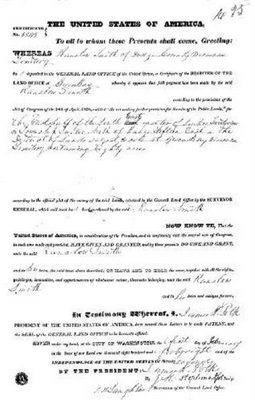
I then wrote down the legal land description from the second screen, like Linda Schreiber suggested, and went to the Standard tab on the first screen, and input the land description, and came up with a list of the others who bought in the same section/township/range. Included in the list was three plots sold to George Smith, including the northeast quarter, where my Ranslow Smith had the southeast quarter.
I have some information that George and Ranslow Smith are brothers.
Thie system described by Linda Schreiber works well - try it, you may find relatives of your people bought land near them.
One of the documents is shown below:
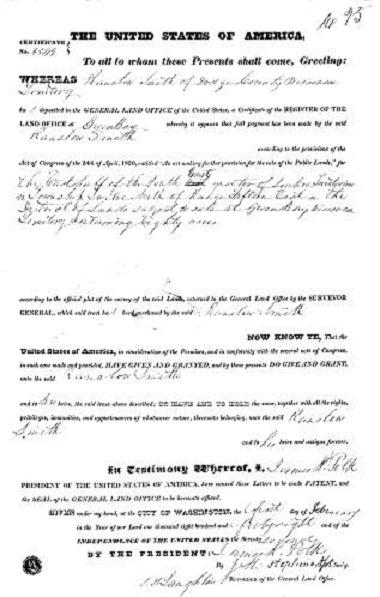
I then wrote down the legal land description from the second screen, like Linda Schreiber suggested, and went to the Standard tab on the first screen, and input the land description, and came up with a list of the others who bought in the same section/township/range. Included in the list was three plots sold to George Smith, including the northeast quarter, where my Ranslow Smith had the southeast quarter.
I have some information that George and Ranslow Smith are brothers.
Thie system described by Linda Schreiber works well - try it, you may find relatives of your people bought land near them.
A Great GLO Records Research Tip
Once in awhile, an absolutely excellent tip is provided on a mailing list by a genealogy researcher. This tip was on the Advanced-Research mailing list several days ago, contributed by Linda Schreiber. I contacted Linda to see if I could post her tip, and she graciously agreed, and added more information to the list post. Here is Linda's tip on using the US Government BLM General Land Office (GLO) records:
-------------------------------------------
GENERAL LAND RECORDS SEARCHES
by Linda Schreiber
http://www.glorecords.blm.gov is one of my favorite research sites. Most genealogy research here is a search for names and locations. But there's another *very* useful capability at the GLO records site. It has led me to a number of breakthroughs.
Sounds trickier than it is. Actually quick and easy. You just need to understand how things were numbered, and the 'visitor center' at the site has nice clear help with this under 'rectangular survey system'. Be sure to print out the "diagram of a theoretical township"..... it really helps to have this at hand. The sections are numbered in an odd way, but this diagram gives you not only the numbering pattern within the township but also the section numbers at the edges for adjoining townships. Very helpful!
Once you find a person of interest in the basic name search, be sure to also hit the 'legal land description' tab. Jot down at least the section, township, range, and meridian. Then go back to the beginning search page where you put in the surname. Hit the "standard" search tab.
Scroll down to the 'land description' section. Put in the section #, township # and direction, ditto range. Select the meridian from the list. Hit search. This will provide a list of names of others with land in that section.
Then treat your person's section as a centerpoint, and get the lists of the folks in the surrounding sections. If your center section is on a township border, get the adjoining sections in the township next door. For instance, if your person is in section 19 of the township 13N 17W, this section is on the western border of his township. His neighboring sections would be 18, 17, 20, 29 and 30 in that township. And also 13, 24 and 25 in township 13N *18* W.
And the website works smoothly. When you get your list and hit the back button, your info is not wiped. All you have to do is change 19 to 18 and hit search, etc.
I have found more in-laws, step-brothers, maternal cousins, will witnesses, old neighbors from earlier locations, that I did not even know were in the area....... If you wanted to take the time, and work with the aliquot parts as well, you could literally recreate the plat map with names on specific lands. I haven't gone that far yet.
Even though only the original purchaser of the government land shows up in the database, and even though it does not cover the earliest eastern states or Texas, this website is an amazing help for genealogists.
----------------------------------------
My thanks to Linda for sharing her research tip with the list members, and her willingness to let me publish it on my blog.
The mailing lists occasionally receive wonderful nuggets like this that can help researchers find useful information. I subscribe to a number of them - do you?
-------------------------------------------
GENERAL LAND RECORDS SEARCHES
by Linda Schreiber
http://www.glorecords.blm.gov is one of my favorite research sites. Most genealogy research here is a search for names and locations. But there's another *very* useful capability at the GLO records site. It has led me to a number of breakthroughs.
Sounds trickier than it is. Actually quick and easy. You just need to understand how things were numbered, and the 'visitor center' at the site has nice clear help with this under 'rectangular survey system'. Be sure to print out the "diagram of a theoretical township"..... it really helps to have this at hand. The sections are numbered in an odd way, but this diagram gives you not only the numbering pattern within the township but also the section numbers at the edges for adjoining townships. Very helpful!
Once you find a person of interest in the basic name search, be sure to also hit the 'legal land description' tab. Jot down at least the section, township, range, and meridian. Then go back to the beginning search page where you put in the surname. Hit the "standard" search tab.
Scroll down to the 'land description' section. Put in the section #, township # and direction, ditto range. Select the meridian from the list. Hit search. This will provide a list of names of others with land in that section.
Then treat your person's section as a centerpoint, and get the lists of the folks in the surrounding sections. If your center section is on a township border, get the adjoining sections in the township next door. For instance, if your person is in section 19 of the township 13N 17W, this section is on the western border of his township. His neighboring sections would be 18, 17, 20, 29 and 30 in that township. And also 13, 24 and 25 in township 13N *18* W.
And the website works smoothly. When you get your list and hit the back button, your info is not wiped. All you have to do is change 19 to 18 and hit search, etc.
I have found more in-laws, step-brothers, maternal cousins, will witnesses, old neighbors from earlier locations, that I did not even know were in the area....... If you wanted to take the time, and work with the aliquot parts as well, you could literally recreate the plat map with names on specific lands. I haven't gone that far yet.
Even though only the original purchaser of the government land shows up in the database, and even though it does not cover the earliest eastern states or Texas, this website is an amazing help for genealogists.
----------------------------------------
My thanks to Linda for sharing her research tip with the list members, and her willingness to let me publish it on my blog.
The mailing lists occasionally receive wonderful nuggets like this that can help researchers find useful information. I subscribe to a number of them - do you?
Tuesday, October 17, 2006
10th Edition of Carnival of Genealogy is Up
I look forward twice a month to the next "Carnival of Genealogy" so that I can read interesting material and perhaps find new genea-bloggers for my perusal.
The 10th Edition of the Carnival of Genealogy was posted today by Jasia on the Creative Gene web site, - the Carnival is here. The subject is Tombstones, and there are many interesting posts in the genea-blogsphere. Click on the links and learn about tombstones, or be entertained by some that are, well, unusual.
The 10th Edition of the Carnival of Genealogy was posted today by Jasia on the Creative Gene web site, - the Carnival is here. The subject is Tombstones, and there are many interesting posts in the genea-blogsphere. Click on the links and learn about tombstones, or be entertained by some that are, well, unusual.
Using visual media to promote your society
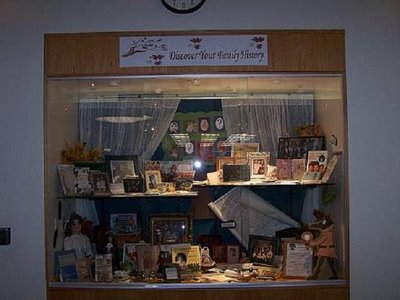
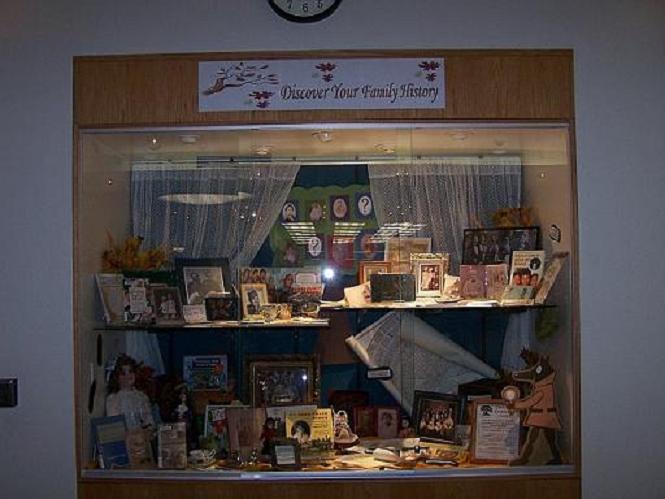
I posted recently about our CVGS/CVPL "Discover Your Family History Day" workshop, held last weekend. As part of this effort, we had the opportunity to put a genealogy/family history display in the library foyer. One of our newer members, Jeanne, had some great ideas, and volunteered to manage the effort. The window has caught the eye of many people, and perhaps some of them may want to learn more about genealogy through CVGS.
The photo below shows the display window (it's about 4 feet high by 6 feet wide):
We also wanted to decorate the conference room we used for the briefing and consulting with the attendees. Our newsletter editor, Shirley, blew up some of her documents and pictures and put them on one conference room wall:
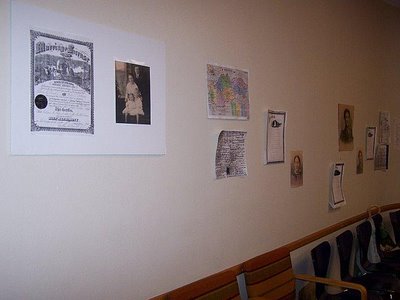
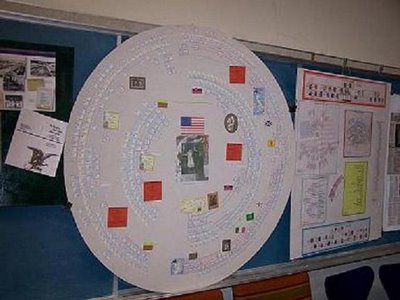
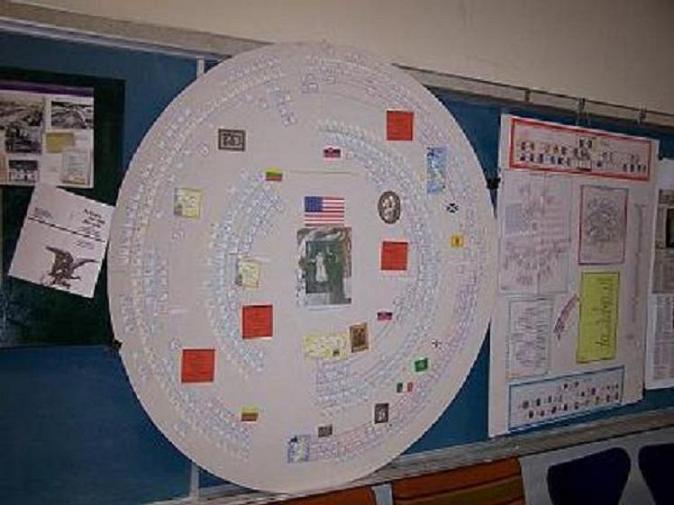
Another newer member, Ken, makes interesting and informative wall charts of his ancestry for his family in his spare time. He brought some of them in and mounted them on the other wall. Here is a photo of some of Ken's work:
In the planning for this workshop, we learned that many of our members have talents we didn't know about, and they used those talents to make the workshop successful. In the process, the attendees and our society members who helped saw some wonderful displays of genealogy and family history.
More and more, we are reminded that learning through visual media is more powerful than learning through lectures or the printed word.
Does your local society have people with hidden talents? How do you encourage your members to reveal and use those talents?
The photo below shows the display window (it's about 4 feet high by 6 feet wide):
We also wanted to decorate the conference room we used for the briefing and consulting with the attendees. Our newsletter editor, Shirley, blew up some of her documents and pictures and put them on one conference room wall:

Another newer member, Ken, makes interesting and informative wall charts of his ancestry for his family in his spare time. He brought some of them in and mounted them on the other wall. Here is a photo of some of Ken's work:
In the planning for this workshop, we learned that many of our members have talents we didn't know about, and they used those talents to make the workshop successful. In the process, the attendees and our society members who helped saw some wonderful displays of genealogy and family history.
More and more, we are reminded that learning through visual media is more powerful than learning through lectures or the printed word.
Does your local society have people with hidden talents? How do you encourage your members to reveal and use those talents?
Randy and his wall chart
I was recently interviewed, via email, by the local newspaper, the weekly Chula Vista Star-News, because of my involvement in the CVGS/CVPL "Discover Your Family History Day" workshop last weekend. I'm told that the article will be published this weekend - we'll see.
They asked me to provide a photograph of me in some genealogy activity. After pondering for some minutes, and rejecting my wife's suggestion to take a picture of me on the computer in my "Genea-Cave," I decided to have her take a picture of me with my ancestral fan chart in front of some of the family photos on the wall in the family room. The picture is below:
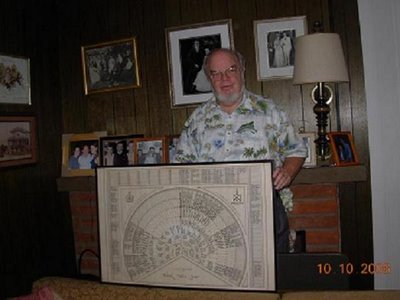
The chart was made about 12 years ago by a genealogy friend who wanted to practice her calligraphy in hopes of building a small business in the genealogy community. The chart is the 10 generation ancestry of my father.
I worked out a way to turn this into a neat Christmas present for my aunts, uncle and cousins. When my friend did the original chart, I had her leave off the name in #1. I had her copy the chart 6 times at the copy shop, and on the copies asked her to put in the names of my father and each of his five siblings on the copies. I then copied those charts at the copy shop so that I could provide one for each of my first cousins plus my 3 living aunts and uncle. They really appreciated it!
After looking at this picture, I realized that I have NOT scanned some of the pictures on the family room wall. They have been there for almost 20 years, and some are the only available copy. I need to scan them ASAP.
Do you have a large wall chart of your ancestry? If so, how do you display it?
They asked me to provide a photograph of me in some genealogy activity. After pondering for some minutes, and rejecting my wife's suggestion to take a picture of me on the computer in my "Genea-Cave," I decided to have her take a picture of me with my ancestral fan chart in front of some of the family photos on the wall in the family room. The picture is below:
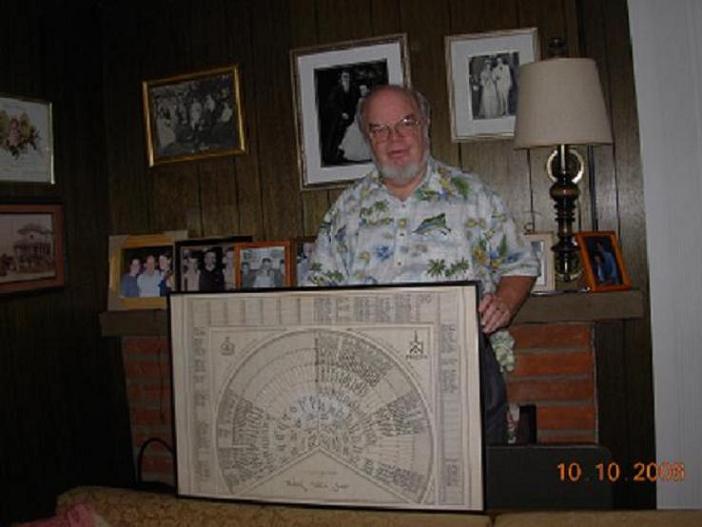
The chart was made about 12 years ago by a genealogy friend who wanted to practice her calligraphy in hopes of building a small business in the genealogy community. The chart is the 10 generation ancestry of my father.
I worked out a way to turn this into a neat Christmas present for my aunts, uncle and cousins. When my friend did the original chart, I had her leave off the name in #1. I had her copy the chart 6 times at the copy shop, and on the copies asked her to put in the names of my father and each of his five siblings on the copies. I then copied those charts at the copy shop so that I could provide one for each of my first cousins plus my 3 living aunts and uncle. They really appreciated it!
After looking at this picture, I realized that I have NOT scanned some of the pictures on the family room wall. They have been there for almost 20 years, and some are the only available copy. I need to scan them ASAP.
Do you have a large wall chart of your ancestry? If so, how do you display it?
Monday, October 16, 2006
FamilySearch and Ancestry - what is coming?
After I posted yesterday about the new Ancestry Member Trees database, I got to thinking - I remembered hearing something very similar from the LDS/FHL/FamilySearch earlier this month - see the discussion of the Deseret News article here.
The new and improved Ancestry and Family Search user-submitted databases sound almost the same, don't they?
Then I thought about the LDS/FHL/FamilySearch announcement several months ago about digitizing the images on all the microfilms and microfiches that are in the LDS vaults, which are accessible through the Family History Library or rental at Family History Centers. The questions I have about the LDS/FHL digitizing include:
1) Census records? American, Canadian, British? Every name index, linked to the images?
2) Vital records? Every name indexed? Only those already filmed?
3) Land, tax and probate records? Every name indexed (or just the grantor, grantee, testator)? Only those already filmed?
4) Newspaper records? Every name indexed? Which ones - only those already filmed?
5) Military records? Every name indexed, or only the soldier/sailor? Only the ones already filmed? Linked to images? All pages of RevWar pension files?
6) Bible records, personal records, manuscripts, church records? Many are on film or fiche.
7) Immigration, passenger lists, naturalization records, etc? Indexed? Linked?
8) Town records, County records, state records? Indexed? Linked?
I've left out quite a few subject areas in my list above, but you get the idea.
If the LDS/FHL digitized and indexed all of the data on the films and fiches, wouldn't that be essentially most of what Ancestry currently has online for a subscription? I assume that Ancestry won't sit still while this happens...perhaps they would concentrate on records not already filmed by the LDS/FHL but are in the public domain.
I'm just a researcher, and a fairly satisfied user of the LDS/FHL films and fiches, the FamilySearch.org site, and Ancestry.com. I look forward to having more documents online and the search process being easier. However, I'm fairly sure that the problems observed on Ancestry and HQO with reading handwriting, transcribing and indexing will remain in all digital databases.
The research resources, and the tools we use to access them, will change over time, and researchers will have to adapt to the new resources and methods. One of my favorite sayings is that "Not all change is progress, but progress only happens through change."
The new and improved Ancestry and Family Search user-submitted databases sound almost the same, don't they?
Then I thought about the LDS/FHL/FamilySearch announcement several months ago about digitizing the images on all the microfilms and microfiches that are in the LDS vaults, which are accessible through the Family History Library or rental at Family History Centers. The questions I have about the LDS/FHL digitizing include:
1) Census records? American, Canadian, British? Every name index, linked to the images?
2) Vital records? Every name indexed? Only those already filmed?
3) Land, tax and probate records? Every name indexed (or just the grantor, grantee, testator)? Only those already filmed?
4) Newspaper records? Every name indexed? Which ones - only those already filmed?
5) Military records? Every name indexed, or only the soldier/sailor? Only the ones already filmed? Linked to images? All pages of RevWar pension files?
6) Bible records, personal records, manuscripts, church records? Many are on film or fiche.
7) Immigration, passenger lists, naturalization records, etc? Indexed? Linked?
8) Town records, County records, state records? Indexed? Linked?
I've left out quite a few subject areas in my list above, but you get the idea.
If the LDS/FHL digitized and indexed all of the data on the films and fiches, wouldn't that be essentially most of what Ancestry currently has online for a subscription? I assume that Ancestry won't sit still while this happens...perhaps they would concentrate on records not already filmed by the LDS/FHL but are in the public domain.
I'm just a researcher, and a fairly satisfied user of the LDS/FHL films and fiches, the FamilySearch.org site, and Ancestry.com. I look forward to having more documents online and the search process being easier. However, I'm fairly sure that the problems observed on Ancestry and HQO with reading handwriting, transcribing and indexing will remain in all digital databases.
The research resources, and the tools we use to access them, will change over time, and researchers will have to adapt to the new resources and methods. One of my favorite sayings is that "Not all change is progress, but progress only happens through change."
Yes, It's Genea-Man
The emergence of "History Woman" (see the post below this one) reminds me that "Genea-Man" showed up at the Chula Vista Genealogical Society meetings back in January, in a presentation I did of "Genealogy Is Fun! Seriously."
With the music of the Superman TV series swelling in the background, the announcer says:
----------------------------------------
Faster Than a Whirling Microfilm Machine.
More Powerful Than a Society Vice-President.
Able to Leap Over Two Gravestones in a Single Bound.
Look – Out In The Stacks! It’s a Nerd – It’s a Geek!
No – It’s "Genea-Man!"
Yes, "Genea-Man." A Strange Visitor from another Library who came to town with research abilities far beyond those of mortal men.
"Genea-Man" – Who can change the course of mighty pedigree charts and find ancestors in obscure documents.
Who, disguised as Randy Seaver, mild-mannered researcher for CVGS, fights a never-ending battle to find the Names, Dates, and Places of his Ancestors.
--------------------------------------------
A bit presumptuous, of course, but it got a laugh. Unfortunately, I couldn't find a cape to swirl around, nor could I find a way to fly in and land on the auditorium stage. No matter...I told them my x-ray vision wasn't working that day, and everybody groaned.
Now I need to get a comic strip started, I guess. Graphic is much better than words.
With the music of the Superman TV series swelling in the background, the announcer says:
----------------------------------------
Faster Than a Whirling Microfilm Machine.
More Powerful Than a Society Vice-President.
Able to Leap Over Two Gravestones in a Single Bound.
Look – Out In The Stacks! It’s a Nerd – It’s a Geek!
No – It’s "Genea-Man!"
Yes, "Genea-Man." A Strange Visitor from another Library who came to town with research abilities far beyond those of mortal men.
"Genea-Man" – Who can change the course of mighty pedigree charts and find ancestors in obscure documents.
Who, disguised as Randy Seaver, mild-mannered researcher for CVGS, fights a never-ending battle to find the Names, Dates, and Places of his Ancestors.
--------------------------------------------
A bit presumptuous, of course, but it got a laugh. Unfortunately, I couldn't find a cape to swirl around, nor could I find a way to fly in and land on the auditorium stage. No matter...I told them my x-ray vision wasn't working that day, and everybody groaned.
Now I need to get a comic strip started, I guess. Graphic is much better than words.
Sunday, October 15, 2006
Meet Super-Hero "History Woman"
Janice at the Cow Hampshire blog introduces the world to "History Woman" at this page: http://cowhampshire.blogharbor.com/seasons/history1.pdf.
"History Woman" is described as:
Pretty cool. If we had had super heroes like this back in high school, I would have become a history and genealogy buff at an earlier age. I remember drooling over Wonder Woman...
I can hardly wait for the next page - will this be a regular comic strip?
"History Woman" is described as:
Who would have figured it? A super heroine who loves history, is faster than a microfiche reader, can jump higher than a bookshelf, and battles history-challenged miscreants.
Pretty cool. If we had had super heroes like this back in high school, I would have become a history and genealogy buff at an earlier age. I remember drooling over Wonder Woman...
I can hardly wait for the next page - will this be a regular comic strip?
Ancestry Member Trees
Ancestry.com announced several months ago (link: http://www.ancestry.com/learn/library/article.aspx?article=11344) that they were going to provide an enhanced "Ancestry Member Tree" which would permit stories, photos, documents and the like to be attached to individuals in the databases uploaded by members to the site.
This service is described in the article as:
There is a Frequently Asked Questions (FAQ) list at http://trees.ancestry.com/pt/learnmore/FAQ.aspx.
In all the hoopla over the completion of the census records, I missed this announcement and the details of this new user-submitted database.
I haven't uploaded my GEDCOM files to anything yet - to Rootsweb WorldConnect, to Ancestry or to GBenealogy.com. My excuse is that I'm "not done yet." I do have it in my genealogy will for my daughters to upload my GEDCOMs in certain places, and to put my unfinished genealogy reports on a web page.
For now, I'm happy carrying my genealogy databases around with me on a flash drive, and in the near future I can put the software and data onto a laptop which my wife is getting for her birthday (don't tell her, please! - it's our secret).
Has anybody uploaded their data to this new Ancestry database? Does anyone have any comments about the ease of uploading, or the ease of finding data in the information already uploaded by genealogists?
This service is described in the article as:
The new Member Trees on Ancestry.com have features similar to family tree software programs available for personal computers—you can create family trees, upload GEDCOM files, and even attach photos to the people in your tree.
But unlike a family tree created on a personal computer, Member Trees are stored online, where you can easily share them with your family and find (or be found by) other family historians searching for the same people. Another benefit of online trees is that you can work on them any where you can connect to the Internet—the library, on vacation, or even when visiting family.
There is a Frequently Asked Questions (FAQ) list at http://trees.ancestry.com/pt/learnmore/FAQ.aspx.
In all the hoopla over the completion of the census records, I missed this announcement and the details of this new user-submitted database.
I haven't uploaded my GEDCOM files to anything yet - to Rootsweb WorldConnect, to Ancestry or to GBenealogy.com. My excuse is that I'm "not done yet." I do have it in my genealogy will for my daughters to upload my GEDCOMs in certain places, and to put my unfinished genealogy reports on a web page.
For now, I'm happy carrying my genealogy databases around with me on a flash drive, and in the near future I can put the software and data onto a laptop which my wife is getting for her birthday (don't tell her, please! - it's our secret).
Has anybody uploaded their data to this new Ancestry database? Does anyone have any comments about the ease of uploading, or the ease of finding data in the information already uploaded by genealogists?
Subscribe to:
Posts (Atom)