Thursday, August 29, 2013

Register Now for Salt Lake Institute of Genealogy (SLIG) 2014

I received this information from Debra Hoffman, SLIG Publicity Chair:

SLIG’s Early-Bird Registration is only weeks away, ending on October 31, 2013! Ensure you get yourself a spot in one of the few remaining courses. The following courses still have seats left:

  • American Research and Records: Focus on Families
  • Advanced Research Tools: Land Records
  • Credentialing: Accreditation, Certification, or Both?
  • Advanced Evidence Analysis Practicum
  • Problem Solving
  • Utilizing Social History
  • Researching in Eastern Europe 
Immerse yourself in a specific genealogical topic for a week-long educational opportunity that is unparalleled. Many of the courses are interactive and highlight on site research at the Family History Library (FHL) as well as one-on-one consultations with the course coordinators and instructors. These individuals are genealogical experts and provide guidance and insight that may help you overcome those brick walls and move forward with your research.

Attendees have time to explore Salt Lake City’s many attractions as well as spend time outside of the course researching at the FHL. The library is a short walk from the Institute’s location and, if available, the Radisson often provides shuttle service to the library.

Another benefit of joining SLIG this year is the ability to attend the Association of Professional Genealogist’s Professional Management Conference (PMC), which will be held the Friday and Saturday before the Institute begins. You can experience two great events being held back-to-back at one location! 


Sign-up before October 31st and you will save over 10% off your registration. Become a member of UGA and increase your savings even more. The registration page can be accessed athttp://www.infouga.org/aem.php?lv=p&epg=51

SLIG runs from January 13 to 17, 2014 in Salt Lake City.  The registration form is at http://www.infouga.org/aem.php?lv=r&eid=8.


Wednesday, August 28, 2013

It's Really Not That Easy!

Did you watch the Cindy Crawford episode on Who Do You Think You Are? last night?  I did.  I liked that she did a little census work herself, then went off to a repository or two for consultations, and then off to England (two locations) and Germany for history lessons.  In the end, she found connections to Ernest Hemingway (a 6th cousin, as I recall), a New England immigrant (Thomas Trowbridge) who left his young children in Connecticut and went back to England, and eventually Charlemagne.


The Ancestry.com blog posted Cindy Crawford: Turning 1,000 Hours of Research into One Hour of Television  today.  Researchers did over 1,000 hours of research in order to glean those three small pieces of Cindy's genealogy and turn them into 40 some minutes of television programming.  Let's see, at what, $100 an hour for professional research (heck, it may be more!), that's $100,000.  If one person had performed that research, it might have taken them several years to find all of the information.

My guess is that they followed several promising paths, once they found the New England connections.  Then they searched for connections between Cindy's New England immigrant ancestors in the early 1600s until they found a likely connection to European royalty.  The latter effort is not difficult - there are several well-sourced books available on European royalty, and especially on English and Scottish royalty.  

What I loved was seeing the ancestral charts that they created for Cindy.  The one with her New England ancestry back to Thomas Trowbridge showed at least one identifiable name in my tree - Amos Gates (I have a sixth-great-grandfather named Amos Gates (1706-1781), but I don't think he was the one on the chart).  I think the one on the chart was Amos Gates (1714-1799) who married Mary Trowbridge; that Amos was a great-grandson of Stephen Gates (I looked in Ancestry Member Trees), my ninth great-grandfather.  So Cindy and I are probably 10th cousins or thereabouts just on our Gates ancestry alone.  That makes me feel important, but I doubt that it would impress Cindy.  

Back to the charts - the roll-out of the large chart (it looked like 5 or 6 feet long) with the ancestry of Thomas Trowbridge back to Charlemagne was equally impressive.  A chart like that would fit nicely on my Genealogy Cave wall - or maybe it could go in the entryway by the front door.  How much does that cost - not the research, just the chart, if I provide the research information?  Because, like most persons with English ancestry, I also have a line back to Charlemagne.  Where's my copy of Gary Boyd Roberts' book The Royal Descents of 600 Immigrants to the American Colies or the United States... I found it.  

Maybe I'll list one of my descents from Charlemagne in another post to impress my readers.  Or add the royal lines to my database so that I can make a chart in RootsMagic (or buy one from Family Chartmasters) - that might impress my heretofore uninterested in genealogy brothers, cousins, daughters and grandchildren.  I can hear it now - "who's Charlemagne?"

The point here is that when you have money and an army of researchers, it's easy to create a story into 40-some minutes of television.  They skipped over about 38 generations of Cindy's ancestors as if they were just names on a chart.  Each of those ancestors contributed their genetic material to create Cindy, and their stories deserves to be told.  But then it would take many more thousands of hours to do the research and write the book and we would never see the results on television.

I bet that there are many more really interesting stories, at least interesting to me, in Cindy's heritage.  If genealogy study really interests her, I hope that she finds the time to pursue all of the ancestors that made her a unique person.  

As for me, I'm having hours of genealogy fun every day reading, writing, researching and working to find records and family stories that define the lives of my own ancestors.  If one of them happens to be one of Cindy's, I'll be happy to share them with her.  Maybe she'll send me an autographed picture of herself that I can put on the wall next to my chart showing my descent from Charlemagne.

I think that the value of Who Do You Think You Are? is the example it sets for the viewing public - that it is possible to find a connection to historical events and significant historical persons, and that there is "help" to do it.  What is missing is how difficult, time consuming and potentially expensive that it really is. 

I think it's fair to say: "It's really not that easy!"

The URL for this post is:  http://www.geneamusings.com/2013/08/its-really-not-that-easy.html

Copyright (c) 2013, Randall J. Seaver

(Not So) Wordless Wednesday - Post 271: Last Day of Spinsterhood

I'm posting family photographs from my collection on Wednesdays, but they aren't Wordless Wednesday posts like others do - I am incapable of having a wordless post.

Here is a photograph from our wedding album:


This photograph was taken on Saturday morning, 21 March 1970 in front of our apartment at 540 C Street, apartment 10 in Chula Vista, California.

This was Linda and my wedding day.  The picture is of my bride-to-be, Linda Joan Leland, 27, looking fairly happy as she spends her last day of spinsterhood preparing for our marriage ceremony at 2 p.m. at Chula Vista Presbyterian Church.  

That is her 1968 Ford Mustang in back of her - we loved that car!

The URL for this post is:

Copyright (c) 2013, Randall J. Seaver

Tuesday, August 27, 2013

More Puzzling Over Ancestry.com "Suggested Records"

After I wrote Puzzling Over How Ancestry.com Finds Suggested Records on 26 August, there were several comments from readers who thought that the "Suggested Records" were generated from records attached to someone's Ancestry Member Trees.  Some of the comments:

*  Sara Gredler said:  "Hmmm, my impression (in my experience and reading your workflow above) was that those Suggested Records *are* based on what has been attached to Ancestry.com trees, which is why on the 1880 census record showed up as a suggested record on other census hits but not others. I have always taken the 'Suggested Records' as a collective."

*  Geolover said:  "I agree with Sara's impression. Sometimes I see items for completely wrong names that would never be retrieved in a search. Since there is no link directly to others' savings, this is hard to check."

*  Taco Gouloose said:  "As far as I can tell, it's some algorithm that displays records that are attached to one individual within other Ancestry Member Trees, together with the record that you have currently selected. If a large selection of AMT's have the same set of records attached to an individual, Ancestry can offer up that set as 'suggested records'. The reason why it will show you wrong records sometimes, is the rampant, unverified copying of information from other AMT's by other Ancestry users, including wrongly sourced individuals. When enough people copy that wrong information to their own tree, it will show up as a suggested record at some point or other. Just my two cents."

I don't know if these folks are correct or not, and I went another step to determine if they were.

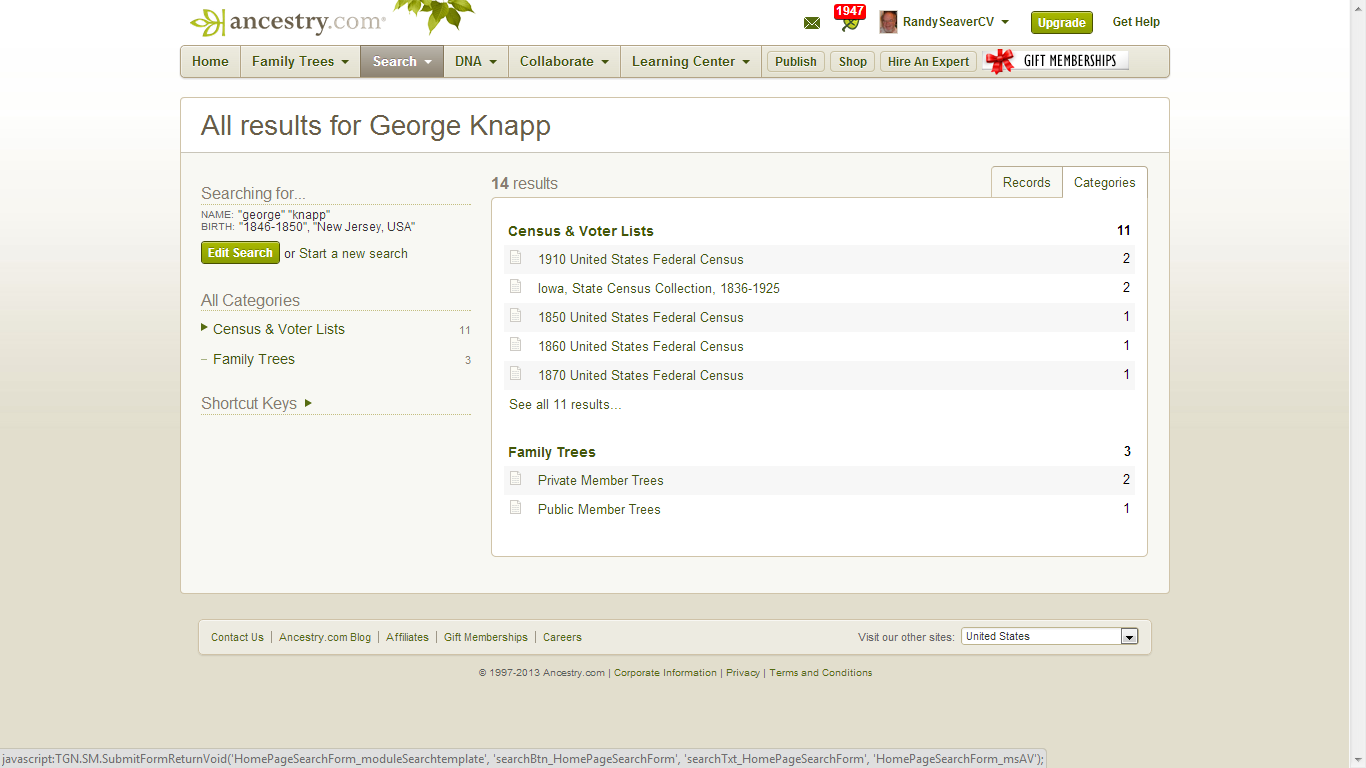
I searched for Ancestry Member Trees with George S. Knapp in them, using the same search I did yesterday:


There were only 3 Ancestry Member Trees with this George Knapp - 2 are Private and 1 is Public.

The two Private trees are:


One of them has no attached records, and the second one has 7 attached records.  I don't know which 7 records those attachments are, but they are probably U.S. census records.

The Public Member Tree is my own:


I have 2 sources, but no attached records in that tree.  

As I recall, I found 12 different records for this George Knapp using the search results and the "Suggested Records" hints (8 U.S. census records, and 4 Iowa state census records).  

Russ Worthington also has a Private Member Tree that he added when he helped me in late 2011 try to sort out the Knapp ancestry.  He attached the 1850, 1860 and 1870 U.S. census records to that tree.  However, this tree does not show up in the Private Member Tree list, probably because he used a setting to not search this tree.

The point is that my search results and the "suggested records" provide 12 found records, while the searchable Private and Public Trees provide only 7 attached records.  Where did the other "suggested records" come from?  I think that Ancestry found them by searching using the given search parameters.  

I don't know yet if Ancestry used the Ancestry Member Trees attachments - it's possible, and it makes sense that they would do that (heck, I would do that if I was programming this  (it's "low hanging fruit").  But then, since there were quite a few George Knapp's in the census records born in the 1846-1850 time frame (but only one in new Jersey), why don't those "not-the-right-George" records show up in the "Suggested Records?"  Several of them do, when the search engine found records that might be the right George Knapp.

If Ancestry.com is using Attached Member Tree attachments, then I wonder why the full list of "Suggested Records" isn't on every record summary.  In other words, for the 1880 U.S. census record, there were only 4 "Suggested Records" shown, so why aren't the other 7 "Suggested Records" shown (assuming they are all attached to an Ancestry Member Tree)?  

What if I was able to find someone in the records, that had "suggested records," but wasn't in an Ancestry Member Tree?  Would that be convincing that Ancestry.com is only doing a search and not using Ancestry Member Trees for "suggested records?"  Turn it around - what if I was able to find someone in an Ancestry Member Tree with attached records, but had no suggested records when I find a record for that person?

My hypothesis is that Ancestry.com is using search results AND attached records to Ancestry Member Trees for a specific person.  I think I've shown that they are doing searches.  I am not convinced that they are using Ancestry Member Tree attachments to drive "Suggested Records."  I think it's possible that they are not using any Ancestry Member Tree attachments as "Suggested Records."

I'm not sure that it matters a whole lot, other than for our wonderment and amusement, but it's something I've been thinking about.

The URL for this post is:  http://www.geneamusings.com/2013/08/more-puzzling-over-ancestrycom.html

Copyright (c) 2013, Randall J. Seaver

Ancestry.com Raises US Subscription Price to $99 for 6-months

Ancestry.com has raised their price for a 6-month U.S. Discovery subscription to $99. Here is a screen shot:


Previously, The price was $19.95 per month and $77.70 for a six-month subscription.

It appears that the World Explorer subscription price has remained at the previous $34.99 per month and $149 for six-months.

I believe that the per-month price for the U.S. subscription will increase in mid-September to something above $20 (my guess is $22.99).  There is a "special pricing note at the top of the screen, and the small print at the bottom of the page says:

"*Offer ends on September 17, 2013 at 10pm ET. You will be charged the promotional price of $19.99 plus applicable tax for the first month of your membership. Subsequent months of your membership will be billed at the then standard pricing."

No one likes price increases, and Ancestry is very likely to suffer a significant drop in their number of long-term subscribers if they get angry and frustrated by the price increase for the U.S.  It may also drive some U.S. subscribers to go for the World subscription because it is only $50 more every six months.

At $99 for six months, that is 54 cents ($0.54) per day, which is a pittance to many people if they use the service on a near daily basis.  I do, and I will pay the increased price, since Ancestry.com remains a vital resource for my daily research efforts.

Now I'm wondering if I can subscribe to Ancestry.com for longer than six months.  Can I subscribe for one year?  How about two years? Ten years?  At the $99 for six months price?  Will they give me a discount for longer term?  Most companies will.

I was alerted to this event by Katherine Rudolph's post on the Transtional Genealogists Forum mailing list today - see Katherine's message at http://archiver.rootsweb.ancestry.com/th/read/TRANSITIONAL-GENEALOGISTS-FORUM/2013-08/1377619875.  Thank you, Katherine, for being sharp-eyed this morning!

The URL for this post is:  http://www.geneamusings.com/2013/08/ancestrycom-raises-us-subscription.html

Copyright (c) 2013, Randall J. Seaver


Tombstone Tuesday - Crittenden at Mount Hope Cemetery in San Diego

I photographed more gravestones at Mount Hope Cemetery last week while I was chasing down the stone for my Stephen-Hassard correspondent (I wrote about it in A Visit to Mount Hope Cemetery in San Diego). 

I photographed only "interesting to me" stones that were in sunlight (it was really bright last Friday!).  

One of the stones, and several surrounding stones, were the Crittenden family:


In front of this larger stone are six smaller stones, the closest four are:


And off to the side of the large upright stone is:


You can see why my curiosity for this set of gravestones was piqued - why did Barbara and John Crittenden have a middle name of Seaver?  Is Barbara a wife of one of the Crittenden sons?  Is John one of their sons?  I don't know...yet.

Now I know - I checked my genealogy database!  Howard Baldwin Crittenden (1908-1986, on the upright gravestone) married Barbara Seaver (1910-1997, daughter of Walter Hibbard and Grace (Whittemore) Seaver) in about 1937, and had a son John Seaver Crittenden (26 June 1939 to 30 July 1960).  They also had two other children (according to the California Birth Index, 1905-1997) - Grace born in 1947 and Howard Baldwin born in 1952.    

It turns out that Barbara (Seaver) Crittenden is my seventh cousin three times removed (at least in my Seaver line).  Our common Seaver ancestor is Robert Seaver (1608-1683).

Howard Baldwin Crittenden (1908-1986), Barbara (Seaver) Crittenden (1910-1997) and John Seaver Crittenden all died in the Bay area, not in San Diego.  However, they are buried in San Diego with their Crittenden parents and grandparents.  They are in the Mount Hope Cemetery listing on the http://files.usgwarchives.net/ca/sandiego/cemeteries/mthope-c.txt website (with several names misspelled!).  Now I can add a burial fact to my database for all three of them.

The URL for this post is:

Copyright (c) 2013, Randall J. Seaver

Monday, August 26, 2013

Puzzling Over How Ancestry.com Finds Suggested Records

One of the features I really like on Ancestry.com is the "Suggested Records" found after a searcher has found one record for a person.  Let me use George Knapp, born in 1848 in New Jersey, as an illustration.  He's my first cousin, three times removed (a first cousin of my second great-grandmother, Sarah (Knapp) Auble.  He is in my database and I want to add his wife and children to my database, and perhaps find male descendants for a Knapp Y-DNA connection.

1)  I did a search for George Knapp, born 1848 (plus/minus 2 years) in New Jersey, with the exact match box checked, on Ancestry.com:


I think that Ancestry.com changed the relative size of their search screen here, and added some color background to dropdown fields.  This is, I think, part of their "coming changes."

2)  Here are the search results:


There are matches shown for the 1850, 1860, 1870, 1900, 1910, 1920 and 1930 U.S. census;  note that there is no 1880 U.S. census match.  There are also matches in the Iowa State Census collection, 1836-1925, and in the Iowa State Census, 1895.

There were no matches in any other record collection except for the Public and Private Member Trees on Ancestry.com.

3)  I started with the 1850 U.S. census, and there is George as a 2 year-old male in the home of Charles and Sarah Knapp, with 3 other young Knapps and one Smith:


There were no "Suggested Records" to the right of the image thumbnail.

4)  The 1860 U.S. Census record shows George S. Knapp, age 12, with Charles and Sarah Knapp, 5 other Knapp persons, and a Shrader:


Over on the right side of the screen are suggested records for:  1930, 1920, 1910, 1870 U.S. census collections, and two Iowa State Census Collection matches.

5)  The 1870 U.S. Census record shows George S. Knapp, age 23, with Charles and Sarah Knapp, and 4 other Knapp persons:


Over on the right side of the screen are suggested records for:  1930, 1920, 1910, and 1860 U.S. census collections, and two Iowa State Census Collection matches.

6)  The 1880 U.S. Census record (which was not found on the Matches list in the second screen above) shows George S. Knapp, age 32 born in New York, with Mary A. and three Knapp children:


Over on the right side of the screen are suggested records for:  1930, 1900, and two other 1880 possible matches.

7)  The 1900 U.S. Census record shows George I. Knapp, age 52, with Mary A. and two Knapp children:


Over on the right side of the screen are suggested records for:  1930, 1920, and 1910 U.S. census possible matches.

8)   The 1910 U.S. Census record shows George G. Knapp, age 62, with Mary A. and one Knapp child:


Over on the right side of the screen are suggested records for:  1930, 1920, 1900, 1880, 1870 and 1860 U.S. census collections, and two different Iowa State Census matches.

9)  The 1920 U.S. Census record shows George G. Knapp, age 72, with Mary A.:


Over on the right side of the screen are suggested records for:  1930, two 1910, 1900, 1880, 1870 and 1860 U.S. census, and three different Iowa State Census matches.

10)  The 1930 U.S. Census record shows George S. Knapp, age 82, with Mary A.:


Over on the right side of the screen are suggested records for:  1920, two 1910, two 1900, 1880, and 1860 U.S. census, and three different Iowa State Census matches.

11)  Do you see the inconsistencies here?  What I noticed was:

*  The 1850 U.S. census entry was not found in any of the other "Suggested Records."

*  The 1860 U.S. Census entry was not found on the 1880 or 1900 list of "Suggested Records."

*  The 1870 U.S. Census entry was not found on the 1880, 1900 or 1930 list of "Suggested Records."

*  The 1880 U.S. census record was not found in the "Results list" (because his birthplace was listed as New York and not New Jersey), but was found in the "Suggested Records" for 1910, 1920 and 1930.

*  The 1900 U.S. census record was not found on the "Suggested Records" for 1860, 1870 and 1880.

*  The 1910 U.S. Census entry was not found on the 1880 list of "Suggested Records."

*  The 1920 U.S. Census entry was not found on the 1880 list of "Suggested Records."

*  The 1930 U.S. Census entry was found on all of the lists of "Suggested Records" (except for 1850).

I did look at the Iowa State Census collections, and there are entries for 1885, 1895, 1915 and 1925.  The 1925 collection provides the parents' names for George S. and Mary A. Knapp.

12)  What does all of this mean to me?  My conclusions are:

*  A searcher needs to check all of the matches on each "Suggested Records" list (s/he might make a list to save time).

*  If the target person has a somewhat different name (or middle initial), a different residence, or a different birthplace, that target person may not be on some "Suggested Records" list.

*  This "Suggested Records" list is not foolproof, but it works pretty well.  I estimated that it had 80% to 90% accuracy for the Records it finds (meaning the suggested record is the target person), but not for the Records it misses (meaning that it doesn't always find the target person for whatever reason).

*  I believe, but I don't know for sure, that these "Suggested Records" are created dynamically from an actual search with the given search parameters, rather than looking up records attached to one or more Ancestry Member Trees.  I may be wrong!

*  You cannot trust these "Suggested Records" to find every match possible in all of Ancestry's databases, but it really helps pick off the "low hanging fruit."  Many databases don't have a birth year or a birth place, and an exact search will not find those entries.  A searcher should do a name only search, and perhaps a name only plus a state residence search, in order to find the "hiding" entries in the Ancestry databases.  For instance, I did a "George Knapp" exact name and a "Iowa, USA" exact residence search and found his marriage record in 1874 to Mary A. Blessing.  I haven't found his, or Mary's, death record yet.

13)  What are your experiences with the "Suggested Records?"

The URL for this post is:  http://www.geneamusings.com/2013/08/puzzling-over-how-ancestrycom-finds.html

Copyright (c) 2013, Randall J. Seaver


Amanuensis Monday - Post 186: Probate Records of Henry Carringer (1800-1879) in Louisa County, Iowa, Part 2

Genea-blogger John Newmark (who writes the excellent  TransylvanianDutch blog) started a Monday blog theme called Amanuensis Monday. What does "amanuensis" mean? John offers this definition:

"A person employed to write what another dictates or to copy what has been written by another."

The subject today is the probate records of Henry Carringer (1800-1879) of  Columbus City, Louisa County, Iowa.  Part 1 of this series was presented last week in 
Amanuensis Monday - Post 185: Probate Records of Henry Carringer (1800-1879) - Part 1.

He married Sarah Feather (1804-1848) before 1825 in Pennsylvania and they had ten children:

*  Eliza Carringer (1827-1914, married 1758 John Robinson (1814-1867)
*  David Jackson Carringer (1828-1902), married 1851 Rebecca Spangler (1832-1901)
*  George Carringer (1832-before 1880), married 1864 Mary --?-- (1845-????).  Mary (--?--) Carringer married (2) James McLaughlin
*  Cornelius A. Carringer (1834-1916), married (1) 1859 Elizabeth Green (1834-1870), married (2) 1871 Nancy Elizabeth Donaldson (1852-1908)
*  Mary Carringer (1835-1908)
*  Sarah Carringer (1837-????)
*  Henry Carringer (1839-1864)
*  Louisa M. Carringer (1842-????)
*  Matilda Spangler Carringer (1845-1911), married 1867 John Spencer Moore (1838-1908)
*  Harvey Carringer (1848-1870)

Henry Carringer died intestate, and his probate papers are in Volume 5 of the Louisa County, Iowa Probate court records.  D.W. Moore was appointed administrator for the estate.  Three documents in the probate case, dated 13 September 1881, are the Appointment of a Guardian for Wilbert H. Carringer, Approval of the Inventory taken by the administrator and appraisers, and the Allowance of a Claim by Mary Carringer:


page 49:

In the Matter of Guardianship}
of Wilbert H. Carringer               } Guardian appointed

And now on this 6th day of November 1880 is presented the petition of Wilbert H. Carringer a minor and resident of the State of Pennsylvania representing that he has property in this State needing the ???? of a Guardian and asking the appointment of Francis I. Moore as Guardian of William H. Carringer minor heir of Geo. W. Carringer Dec^d and it appearing that there is need of such Guardian and that he is a proper person to act he is required to give bond, in the here?? sum of two thousand dollars conditioned according to him which being done with TW Brown and JJ Moore Sureites and Said Bond being approved and the Said F.I. Moore having to R??? and Subscribed the oath Required by Law he is appointed as Guardian of said Wilbert H. Carringer minor and Letters of Guardianship are allowed to him accordingly.

Page 232:

In the Matter of the Estate}
of Henry Carringer Decd    } Inventory Approved

And Now on this on this 13th day of September 1881 comes D.W. Moore Admin of the Estate of Henry Carringer Decd and files his Inventory and Statement of heirs Said Inventory showing that no personal property came into the hand of said administrator and is satisfied by the said administrator as required by Law.

And Said Inventory and Statement of heirs having been seen and examined Ordered that the Same be approved and allowed and entered upon the Complete Probate Records of this Court.

In the Matter of the Estate}
of Henry Carringer Decd    } Allowance of claim Sept 13 1881

And now on this day is presented his administration and the ????? the Admittance of the Claims of Mary Carringer against the Estate of Henry Carringer Decd the same having been Sworn to filed and admitted to be correct in the Sum of $1379.33 by D.W. Moore the Adminr of Said Estate.

And Said claims having been seen and examined Ordered that the admittance of the Same be approved and allowed and that the Adminr of Said Estate pay said claim out of any assets in his hands belonging to Said Estate in Class No. “3” in manner as required by Law.

The source citations for these three documents (using the Probates, bound (FHL microfilm images) source template in RootsMagic) are:

Louisa County, Iowa, District Court Record Books, Volume V, Page 49, Henry Carringer administration, dated 13 September 1881, guardian appointed for Wilbert H. Carringer; accessed on FHL US/CAN Microfilm 1,006,640.

Louisa County, Iowa, District Court Record Books, Volume V, Page 232, Henry Carringer administration, dated 13 September 1881, Inventory approved; accessed on FHL US/CAN Microfilm 1,006,640.

Louisa County, Iowa, District Court Record Books, Volume V, Page 232, Henry Carringer administration, dated 13 September 1881, allowance of claim; accessed on FHL US/CAN Microfilm 1,006,640.

Wilbert H. Carringer was the son of George W. Carringer, who was deceased when his father Henry Carringer (1800-1879) died.  Therefore, George's portion of the estate goes to his son, Wilbert.  Because Wilbert is a minor and residing in Pennsylvania, Wilbert needs a guardian appointed to represent his interests.    

Mary Carringer was an unmarried daughter of Henry Carringer,  It appears that she filed a claim against the estate, and her claim was allowed by the court.  It is not clear what the claim is, or why she filed this claim separately.  There are no other probate papers explaining this claim. 

The third document was approval of the inventory and it has the sentence "And Said Inventory and Statement of heirs having been seen and examined Ordered that the Same be approved and allowed..." which implies that there should be an inventory and a statement of heirs in the probate records.  But there is no such paper(s) in the probate index on the microfilms I examined.  

There is at least one more set of documents in this set of probate records for Henry Carringer (1800-1879).


Copyright (c) 2013, Randall J. Seaver

Family Tree Maker 2014 Software Announced - 30% Discount (or more)

Ancestry.com announced the arrival (soon!) of Family Tree Maker 2014 at the FGS Conference on Saturday.  I received an email today that described the new and enhanced features:

It’s that time again to announce all the greatest new features of Family Tree Maker. We listened to a large range of Family Tree Maker users to improve our features for 2014 including the roll out of the new Family View display, improved TreeSync, more extensive charts and reports, new organizational tools and more. Below is a list of the newly improved features.

  • New Family View — see your family tree in a new way. This additional view makes navigating easier, especially when you want to see extended family members.
  • Improved TreeSync — lets you easily synchronize your tree in Family Tree Maker with an online Ancestry.com tree.
    • A more robust TreeSync™ lets you sync even more of your family tree info.
    • Easily share your tree with your family and work on it together. Family and friends can view the online version of your tree without software or an Ancestry.com subscription.
    • Collaborate with the largest, most active family history community in the world. Keep your online tree private or make it public so that others researching your family can find you. You may connect with others who have insight on your ancestors, discover rare family photos, or even find relatives you didn’t know you had.
  • More organizational tools — stay organized with new tools that let you sort children automatically by birth order and view people by location, grouping them by country, state, county, and city.
  • New and improved charts and reports — more options and views let you display an individual’s ancestors, spouses, and children together. Also, the Index of Individuals Report has been expanded with options for anniversary, birthday, and contact lists and more.
  • New tree branch export — a new export option makes it much simpler to export a single branch of your tree. 
  • More editing options — save time with the ability to copy and paste facts including related source citations, media items, and notes.
  • Improved merging — easily and reliably merge more of the information you find on Ancestry.com.
 Family Tree Maker is a great program to help you organize your family history regardless of your level of expertise. With so many features and options, it’s perfect for the genealogist digging deeper into the past and the family historian fleshing out stories. Some of the additional features you may find helpful include:

1. Access interactive street and satellite maps
View important locations in your ancestors’ lives. Or create a migration map showing where events in ancestors’ lives took place.
2. Easily organize media
Add photos, documents, audio and video in one, easy-to-access location. Link media to multiple people in your tree and incorporate them into charts and reports.
3. Share your work with others
Use templates to create beautiful family trees or design your own with powerful charting tools. Enhance charts with backgrounds, embellishments and family photos.
4. Discover new family members — Follow hints from Ancestry.com, the world's largest family history resource.
5. Create Smart Stories — Transform facts from your tree into stories that update automatically as you change your tree.
6. Simplify source creation — Use templates to source everything from online databases to vital records.
7. Use standard location names — Use the locations database to enter place names consistently and in a standard format.
8. Explore data like never before — Use new and improved reports to gather information and export it in a variety of formats. Save settings in one report and apply them to others.
9. Navigate your tree with ease — View multiple generations, navigate to any individual in your tree with a click of the mouse and add or edit life events.
10. Import data from other genealogy programs — Open files created in Legacy™ Family Tree, The Master Genealogist™ and FamilySearch™ Personal Ancestral files.

Version 2014 is now available for pre-sale at 30% off for the early bird genealogist. You’ll have the option to have it shipped to you or download it the same day shipping begins. The pre-sale discount ends September 10th, so get yours now to take advantage of the 2014 launch.


There are no screen shots of many of the new features.  I captured an image of the "Family View" in the "People" workspace - it looks similar to the "Family View" in an Ancestry Member Tree:


The view above has several icons on the left margin for different views of the family (left to right, top to bottom, etc.).  The view shown has the key person in green, the spouse beside, children below, and three generations of ancestors above.  The "Home" icon takes you to the home person in the tree.  The green leaf Hints also are shown, which provides an easy link to search for records for the selected person.

I, and I'm sure others, will explore, review and evaluate many of the new features once we have our hands on the software and can work with it.

The price break for the pre-sale at at http://www.ancestry.com/cs/apps/P-5194 is attractive.  I believe that the $27.99 price (30% discount) is for a new user - one who is not upgrading.  You can order it by downloading it online or obtain it by mail on a CD.  Apparently, there is another 10% price reduction for an Upgrade to 2014 if you already have FTM 2012.  For my US delivery of an Upgrade it will be $23.99 to download, $23.99 plus $5 for shipping and $2.32 for California state tax (total of $31.31) if I order it on a CD.

What I don't know is this:  Do I need to get the CD in order to install it on my desktop computer and my laptop computer?  Is this possible with the Download selection?  Is there an added cost for a second (or third) installation?

  I will be following this release of FTM 2014 closely, and will test it with my own interests when I receive it.

The URL for this post is:  http://www.geneamusings.com/2013/08/family-tree-maker-2014-software.html

copyright (c) 2013, Randall J. Seaver

Sunday, August 25, 2013

Best of the Genea-Blogs - 18 to 24 August 2013

Hundreds of genealogy and family history bloggers write thousands of posts every week about their research, their families, and their interests. I appreciate each one of them and their efforts.

My criteria for "Best of ..." are pretty simple - I pick posts that advance knowledge about genealogy and family history, address current genealogy issues, provide personal family history, are funny or are poignant. I don't list posts destined for daily blog prompts or meme submissions (but I do include summaries of them), or my own posts.

Here are my picks for great reads from the genealogy blogs for this past week:


*  Genealogy Hacked: Who's Who in TN Project by Thomas MacEntee on the Hack Genealogy blog.  Thomas interviews Taneya Koonce about this crowd-sourcing indexing and transcription project.

*  Know Your Sources by Michael Leclerc on the Mocavo Genealogy Blog.   Michael describes how different editions of sources can vary, and in the process provides an excellent description of one of the foundational New England sources, Torrey's Marriages to 1700.

*  A Place for Everything by Tony Proctor on the Parallax View blog.  Tony discusses the historical place names issue.  Excellent graphic too!

*  What Are the Genealogical Myths? by James Tanner on the Genealogy's Star blog.  James addresses seven persistent myths - are any of them true?

*  Dear Mother:  Family Letters and Your Genealogy by Gena Philibert-Ortega on the GenealogyBank blog.  Gena emphasizes that not all family letters are found in family papers.

*  Guest Post: What Getting a Credential Meant To Me by Dee Dee King on Harold Henderson's Midwestern Microhistory blog.  Dee Dee describes her path to certification and the rewards of achieving it.

*  Genealogy Bloggers: What Keeps Us Going? by Heather Kuhn Roelker on the Leaves For Trees blog.  Heather provides her answers- great insight here.

*  People Timelines by Michele Simmons Lewis on Ancestoring's Ask A Genealogist blog.  Michele demonstrates how timelines can be used to show events in a person's lifetime.


*  On the Trail of Johnny Appleseed by Heather Wilkinson Rojo on the Nutfield Genealogy blog.  Heather is a distant cousin, and I learned that I am too!

*  The Father's Waltz by Stepper McCrery on the Family Storytelling blog.  I remember...thanks, Stepper!

*  A Higher Level of Learning by Darcie Hind Posz on Angela McGhee's Adventures in Genealogy Education.  Darcie shares her education journey, and especially her 2013 SLIG course.

These genea-bloggers wrote weekly pick posts and news summary posts this week:

*  Follow Friday - Favorites for August 23, 2013 by Heather Kuhn Roelker on the Leaves For Trees blog.

*  News and Stories for Genealogists, August 23, 2013 by Michael Leclerc on the Mocavo genealogy Blog.

*  Follow Friday - Fab Finds for August 23, 2013 by Jana Last on Jana's Genealogy and Family History Blog.

*  Saturday Serendipity (August 24, 2013) by John D. Tew on the Filiopietism Prism blog.

Readers are encouraged to go to the blogs listed above and read their articles, and add their blogs to your Favorites, Feedly, another RSS feed, or email if you like what you read. Please make a comment to them also - all bloggers appreciate feedback on what they write.

Did I miss a great genealogy blog post? Tell me! I am currently reading posts from over 1400 genealogy bloggers using Feedly, but I still miss quite a few it seems.


Read past Best of the Genea-Blogs posts here.

The URL for this post is:   
http://www.geneamusings.com/2013/08/best-of-genea-blogs-18-to-24-august-2013.html

Copyright(c) 2012, Randall J. Seaver