A king or queen for America? Surely, you jest, Megan Smolenyak. A descendant of George Washington's father?
It's an interesting research problem, and Megan has a fun (?) time of it in the latest Ancestry Magazine cover story, The Man (or Woman) Who Would Be King. I learned a lot about royal succession. I'm not sure I understand it all, but now "agnate" and "cognate" are in my mental dictionary.
Of course, the course of Washington's family lines might have been different if George had agreed to be King. Where would the capital have been? Would we have royal castles spotted around the country? Would there have been a rebellion against King George I or his successors? Heck, would GW even have taken the title King George I - perhaps he would have selected another name!
It's a great article by Megan, please read it if you are a student of royalty or history. The whole story is an example of one of my favorite sayings - "there are moments in time that take a lifetime to explain."
By the way, did you notice that there is an article archive at http://www.ancestrymagazine.com/ for past issues?
Saturday, September 13, 2008

Passed away "...due to complications resulting from her children making her old before her time"
An "interesting" obituary was printed recently in the Akron (OH) Beacon-Journal newspaper for Ruth E. (Secrist) Rencevicz - you can read it on Legacy.com here.
If everything they say about her is true, she had a really interesting life. She was a full-time mom, a switchboard operator, a CIA cold-war spy, a neighborhood volunteer trying to help young people, stalked Peter Jennings, and was abducted by aliens. Oh, she had a child conceived when the circus was in town, too.
I wonder how much of this obituary she wrote herself? If she didn't write it, then it sounds like her children wrote all of the stories down just for this occasion. The last paragraph:
"Ruth was adamant that people use the occasion of her passing to remember and celebrate her life. In lieu of formal funeral proceedings or viewing hours, she requested that those who remember and cared about her share both a special memory and a drink in her honor. Preferably Bud Light Lime, or if that's not available, gasoline or floor wax."
Thank goodness I don't have any gasoline or floor wax handy, or Bud Lite for that matter. But I will raise my water bottle here in the Genea-Cave and say:
"Here's to Ruth, who I didn't know but I wish I had! May the memory of your life, and your sense of humor, remain with your progeny through many generations."
Click on the Guest Book page here, and read some of the 31 pages of comments about Ruth. We should all be so lucky to touch so many people in a positive way.
If everything they say about her is true, she had a really interesting life. She was a full-time mom, a switchboard operator, a CIA cold-war spy, a neighborhood volunteer trying to help young people, stalked Peter Jennings, and was abducted by aliens. Oh, she had a child conceived when the circus was in town, too.
I wonder how much of this obituary she wrote herself? If she didn't write it, then it sounds like her children wrote all of the stories down just for this occasion. The last paragraph:
"Ruth was adamant that people use the occasion of her passing to remember and celebrate her life. In lieu of formal funeral proceedings or viewing hours, she requested that those who remember and cared about her share both a special memory and a drink in her honor. Preferably Bud Light Lime, or if that's not available, gasoline or floor wax."
Thank goodness I don't have any gasoline or floor wax handy, or Bud Lite for that matter. But I will raise my water bottle here in the Genea-Cave and say:
"Here's to Ruth, who I didn't know but I wish I had! May the memory of your life, and your sense of humor, remain with your progeny through many generations."
Click on the Guest Book page here, and read some of the 31 pages of comments about Ruth. We should all be so lucky to touch so many people in a positive way.
Friday, September 12, 2008
I need advice - the best way to contact a living relative
My research on my Project M, being conducted for my friend Ed who lives here in Chula Vista and is slowly dying at age 81. He wanted to know more about his father's life - Ed last saw his father in 1943 in Georgia.
In the six weeks I've worked on this project off and on, I've found the father's SSDI record (and sent off for the SS5) - he died in 1969 in southern Georgia. I gathered online information and have constructed a decent family tree of Ed's paternal and maternal ancestry. The other night, I found the obituary for Ed's half-sister in a local Georgia newspaper that listed the names of her parents, her husband, her children and her siblings (but not Ed). From that, I could tell that she and Ed were half-siblings. Today, I found several more articles - obituaries and a wedding announcement - that gave me more information on family members. After using www.veromi.net, the Public Records search on Ancestry, the www.411.com search, etc., I think I have addresses and telephone numbers for the three living half-siblings and one of the half-nephews of Ed's. I have not found any email addresses - yet!
Now the problem is how to contact them. Should I:
1) Telephone one or more of them?
2) Write a nice letter to them?
3) Should I do it, or should Ed?
I'm thinking that I should make the first contact, and try to set up a phone call to them with Ed as a second contact. I could explain why I'm contacting them without it being an emotional event. The problem is that they might not welcome the contact and shy away from talking to Ed if I mess up the first contact.
Ed only wants information about his father's life. I know he would love to hear stories about his father's military service, his occupations and jobs, his hobbies and interests, his religious beliefs, his health history, etc. I know that he would like to know where his father is buried. I know that he would really like to have photographs of his father.
So - I want your advice. Have you done this before? What worked? What didn't work? Were you successful? What kinds of responses might I encounter? How can I maximize the chance of a positive response?
In the six weeks I've worked on this project off and on, I've found the father's SSDI record (and sent off for the SS5) - he died in 1969 in southern Georgia. I gathered online information and have constructed a decent family tree of Ed's paternal and maternal ancestry. The other night, I found the obituary for Ed's half-sister in a local Georgia newspaper that listed the names of her parents, her husband, her children and her siblings (but not Ed). From that, I could tell that she and Ed were half-siblings. Today, I found several more articles - obituaries and a wedding announcement - that gave me more information on family members. After using www.veromi.net, the Public Records search on Ancestry, the www.411.com search, etc., I think I have addresses and telephone numbers for the three living half-siblings and one of the half-nephews of Ed's. I have not found any email addresses - yet!
Now the problem is how to contact them. Should I:
1) Telephone one or more of them?
2) Write a nice letter to them?
3) Should I do it, or should Ed?
I'm thinking that I should make the first contact, and try to set up a phone call to them with Ed as a second contact. I could explain why I'm contacting them without it being an emotional event. The problem is that they might not welcome the contact and shy away from talking to Ed if I mess up the first contact.
Ed only wants information about his father's life. I know he would love to hear stories about his father's military service, his occupations and jobs, his hobbies and interests, his religious beliefs, his health history, etc. I know that he would like to know where his father is buried. I know that he would really like to have photographs of his father.
So - I want your advice. Have you done this before? What worked? What didn't work? Were you successful? What kinds of responses might I encounter? How can I maximize the chance of a positive response?
CVGS Research Group Report - 10 September 2008
The September meeting of the Chula Vista Genealogical Society Research Group was on 10 September at the Library. There were 14 attendees at this meeting, and they all had something to share. We started with a brief review of some of the Genealogy News highlights as discussed here.
Then we went around the table and each person shared their research efforts over the past month or so:
* John founds some interesting books on New Hampshire genealogy at Carlsbad Library. He has been researching his daughter-in-law's English family, and ordered two birth records through the FreeBMD service.
* Angie is working on the German and English ancestry of one great-grandmother, and the Spanish ancestry of her other great-grandparents. She found a census record for her grandfather.
* Joan has been searching for more newspaper articles from the 1915-1920 period for her mother-in-law. She passed around one clipping of Ann Darling (her stage name).
* Dearl has his new computer running, and has been reorganizing his paper files.
* Dave has been working in FTM 2008. He is trying to download a GEDCOM of his database on Ancestry so that he can use it in FTM 2008 without re-entry of data.
* Terry enjoyed the Carlsbad Library trip, where he got a library card. He has been working in HeritageQuestOnline trying to find census records. He made an Inter-Library Loan request to Oklahoma to find a newspaper article about his grandfather's accidental death.
* Bobbie has been trying to find immigration dates for her father's German Titus line. She went to a recent GRA meeting and asked the speaker for some help. He provided the name of another researcher in Germany, whose wife is Bobbie's distant cousin. They are exchanging information.
* Bob T asked where he might find records from Czech Republic and Hungary before 1910. He only knows his grandfather's birth date and approximate location. The group suggested checking message boards, the FEEFHS organization, and determine if the LDS FHLC has films for his localities.
* Olive just started doing research. She knew the name of one great-grandparent before she went to a family reunion and received information from a nephew with lots of ancestral information. She wanted to know how to effectively do genealogy research.
* Virginia took a trip to Indiana to visit the Allen County Public Library genealogy holdings (it's a big place, she said!) and found three books she was looking for. She then went to the Midwestern Roots Genealogy conference for two days and brought back a syllabus and several useful genealogy items, including a genealogy clipboard and a small ring notebook that holds foldout family group sheets.
* Dick has done a bit more on his aunt's military records, and is attending Judy Helton's weekly genealogy classes at Chula Vista Adult School.
* Charlotte had a long road trip across the USA. In Kentucky, she met a second cousin with a wealth of family photographs. The cousin's scanner died, so she will send images to Charlotte later. She and her cousin found that they had received similar dolls from two generations of grandmothers.
* Bob P. had a response to a message board post from 2001, and is working with his correspondent. He signed up for the $89 Y-DNA test on Ancestry DNA.
* Randy discussed his Carlsbad Library finds, and passed several copies around. He discussed his success finding an obituary on Google News Archive Search, and passed it around.
We had only one problem solving question:
* Bobbie has been looking for male Titus cousins to take part in a Y-DNA study. She has 1930 census data, and identified cousins, and their male children, in California, Arizona, Michigan and New Jersey. She has made two calls to cousins, provided family information to them, but they have not yet agreed to do the test. She's going to work on living male cousins in the other states. The group suggested www.veromi.net and www.411.com as the best people-finder site for living people.
Look at that list of 14 people and the variety of experiences, localities and research topics we talked about this month. The time went by extremely fast!
The CVGS Research Group meets every second Wednesday at 12 noon in the Conference Room at the Chula Vista Civic Center Branch Library. The group shares their experiences, passes around interesting and helpful documents for show-and-tell, and tries to help attendees solve their research problems.
Then we went around the table and each person shared their research efforts over the past month or so:
* John founds some interesting books on New Hampshire genealogy at Carlsbad Library. He has been researching his daughter-in-law's English family, and ordered two birth records through the FreeBMD service.
* Angie is working on the German and English ancestry of one great-grandmother, and the Spanish ancestry of her other great-grandparents. She found a census record for her grandfather.
* Joan has been searching for more newspaper articles from the 1915-1920 period for her mother-in-law. She passed around one clipping of Ann Darling (her stage name).
* Dearl has his new computer running, and has been reorganizing his paper files.
* Dave has been working in FTM 2008. He is trying to download a GEDCOM of his database on Ancestry so that he can use it in FTM 2008 without re-entry of data.
* Terry enjoyed the Carlsbad Library trip, where he got a library card. He has been working in HeritageQuestOnline trying to find census records. He made an Inter-Library Loan request to Oklahoma to find a newspaper article about his grandfather's accidental death.
* Bobbie has been trying to find immigration dates for her father's German Titus line. She went to a recent GRA meeting and asked the speaker for some help. He provided the name of another researcher in Germany, whose wife is Bobbie's distant cousin. They are exchanging information.
* Bob T asked where he might find records from Czech Republic and Hungary before 1910. He only knows his grandfather's birth date and approximate location. The group suggested checking message boards, the FEEFHS organization, and determine if the LDS FHLC has films for his localities.
* Olive just started doing research. She knew the name of one great-grandparent before she went to a family reunion and received information from a nephew with lots of ancestral information. She wanted to know how to effectively do genealogy research.
* Virginia took a trip to Indiana to visit the Allen County Public Library genealogy holdings (it's a big place, she said!) and found three books she was looking for. She then went to the Midwestern Roots Genealogy conference for two days and brought back a syllabus and several useful genealogy items, including a genealogy clipboard and a small ring notebook that holds foldout family group sheets.
* Dick has done a bit more on his aunt's military records, and is attending Judy Helton's weekly genealogy classes at Chula Vista Adult School.
* Charlotte had a long road trip across the USA. In Kentucky, she met a second cousin with a wealth of family photographs. The cousin's scanner died, so she will send images to Charlotte later. She and her cousin found that they had received similar dolls from two generations of grandmothers.
* Bob P. had a response to a message board post from 2001, and is working with his correspondent. He signed up for the $89 Y-DNA test on Ancestry DNA.
* Randy discussed his Carlsbad Library finds, and passed several copies around. He discussed his success finding an obituary on Google News Archive Search, and passed it around.
We had only one problem solving question:
* Bobbie has been looking for male Titus cousins to take part in a Y-DNA study. She has 1930 census data, and identified cousins, and their male children, in California, Arizona, Michigan and New Jersey. She has made two calls to cousins, provided family information to them, but they have not yet agreed to do the test. She's going to work on living male cousins in the other states. The group suggested www.veromi.net and www.411.com as the best people-finder site for living people.
Look at that list of 14 people and the variety of experiences, localities and research topics we talked about this month. The time went by extremely fast!
The CVGS Research Group meets every second Wednesday at 12 noon in the Conference Room at the Chula Vista Civic Center Branch Library. The group shares their experiences, passes around interesting and helpful documents for show-and-tell, and tries to help attendees solve their research problems.
Anne (Dudley) Bradstreet (1612-1672) - poetess
One of my 9th great-grandmothers is New England's (America's?) first poetess - Anne (Dudley) Bradstreet. She was born before 20 March 1611/12 in Northampton, Northamptonshire, England (christening); and died 16 September 1672 in Andover, Essex County, MA. She was the daughter of Thomas Dudley and Dorothy Yorke. She married (1) Simon Bradstreet in about 1628 in England. He was born before March 1603/04 in Horbling, Lincolnshire, England, and died 27 March 1697 in Salem, Essex County, MA. He was the son of Simon Bradstreet and Margaret Sawyer.
Her father, Thomas Dudley, and her husband, Simon Bradstreet, were Governors of Massachusetts Bay Colony in the 17th century.
The Mass Moments history blog has a post today about Anne's feelings about moving from comfortable England to the wilds of New England in their post "On This Day..." After immigrating to New England, Anne wrote:
"Bradstreet was only 18 when she arrived in Salem harbor in 1630 on the Arbella. She had been reluctant to say goodbye to her elegant home in England, but her husband, Simon, and stern father, Thomas Dudley, were determined to leave a country whose government was increasingly hostile to critics of the Anglican Church. Later in life, when she wrote that her "heart rose" as she set foot in America, she meant not that she rejoiced, but that she retched.
"Not surprisingly, she was horrified by the harshness of the New World: the "hungry wolves," "stormy rains," and "rugged stones" that she would one day describe in her poetry. Few Englishmen, and even fewer Englishwomen, had ventured to America. When the Arbella's party disembarked, they discovered that the little band of settlers sent to Salem the year before to prepare for the rest of the colonists had been almost obliterated by disease and starvation. The leaders of Bradstreet's group, including her father, husband, and the colony's future governor, John Winthrop, took one look at the miserable little settlement and headed south."
Read the whole thing.
Anne's most famous work was titled "The Tenth Muse," a work of 400 pages, which was published in London in 1650. A second edition was published in 1678 with additional material. This was six years after her death, and Mrs. Bradstreet seems to have had a hand in the revisions. The best edition of her poems is that of John Harbard Ellis, 1867, reprinted 1932. One of her best known poems is:
"To My Dear and Loving Husband
"If ever two were one, then surely we,
If ever man were lov'd by wife then thee;
If ever a wife was happy in a man,
Compare with me ye woman if you can,
I prize thy love more then whole Mines of gold,
Or all the riches that the East doth hold.
My love is such I can no way repay,
The heavens reward thee manifold, I pray,
Then while we live, in love let's so persevere,
That when we live no more, we may live ever. "
Of her children she wrote:
"I had eight birds hatcht in one nest,
Four cocks there were, and hens the rest;
I nurst them up with pain and care,
Nor cost, nor labour did I spare,
Till at the last they felt their wing,
Mounted the trees, and learn'd to sing."
The Mass Moments post says that "...in 2000, several North Shore communities were celebrating 'Anne Bradstreet Week' to mark the 350th anniversary of the poet's death."
Seems to me they were celebrating the 350th anniversary of the publication of Anne (Dudley) Bradstreet's "The Tenth Muse." She died in 1672, not in 1650.
It's neat when you find famous and creative people in your ancestry. I may have just 1 in 2,024 genes from Anne, and I doubt that they included her creativity, but I sure appreciate having her in my ancestry.
Her father, Thomas Dudley, and her husband, Simon Bradstreet, were Governors of Massachusetts Bay Colony in the 17th century.
The Mass Moments history blog has a post today about Anne's feelings about moving from comfortable England to the wilds of New England in their post "On This Day..." After immigrating to New England, Anne wrote:
"Bradstreet was only 18 when she arrived in Salem harbor in 1630 on the Arbella. She had been reluctant to say goodbye to her elegant home in England, but her husband, Simon, and stern father, Thomas Dudley, were determined to leave a country whose government was increasingly hostile to critics of the Anglican Church. Later in life, when she wrote that her "heart rose" as she set foot in America, she meant not that she rejoiced, but that she retched.
"Not surprisingly, she was horrified by the harshness of the New World: the "hungry wolves," "stormy rains," and "rugged stones" that she would one day describe in her poetry. Few Englishmen, and even fewer Englishwomen, had ventured to America. When the Arbella's party disembarked, they discovered that the little band of settlers sent to Salem the year before to prepare for the rest of the colonists had been almost obliterated by disease and starvation. The leaders of Bradstreet's group, including her father, husband, and the colony's future governor, John Winthrop, took one look at the miserable little settlement and headed south."
Read the whole thing.
Anne's most famous work was titled "The Tenth Muse," a work of 400 pages, which was published in London in 1650. A second edition was published in 1678 with additional material. This was six years after her death, and Mrs. Bradstreet seems to have had a hand in the revisions. The best edition of her poems is that of John Harbard Ellis, 1867, reprinted 1932. One of her best known poems is:
"To My Dear and Loving Husband
"If ever two were one, then surely we,
If ever man were lov'd by wife then thee;
If ever a wife was happy in a man,
Compare with me ye woman if you can,
I prize thy love more then whole Mines of gold,
Or all the riches that the East doth hold.
My love is such I can no way repay,
The heavens reward thee manifold, I pray,
Then while we live, in love let's so persevere,
That when we live no more, we may live ever. "
Of her children she wrote:
"I had eight birds hatcht in one nest,
Four cocks there were, and hens the rest;
I nurst them up with pain and care,
Nor cost, nor labour did I spare,
Till at the last they felt their wing,
Mounted the trees, and learn'd to sing."
The Mass Moments post says that "...in 2000, several North Shore communities were celebrating 'Anne Bradstreet Week' to mark the 350th anniversary of the poet's death."
Seems to me they were celebrating the 350th anniversary of the publication of Anne (Dudley) Bradstreet's "The Tenth Muse." She died in 1672, not in 1650.
It's neat when you find famous and creative people in your ancestry. I may have just 1 in 2,024 genes from Anne, and I doubt that they included her creativity, but I sure appreciate having her in my ancestry.
Thursday, September 11, 2008
More thoughts about Footnote.com
I've spent two more hours working on Footnote Pages and in my Gallery on www.Footnote.com. I am a registered member on Footnote, but not a premium (read: subscriber) member, so I cannot access images that are behind the subscription firewall.
In these two hours, I've managed to:
* update my member profile - see http://www.footnote.com/profile/rjseaver/
* Add 11 pictures to my Gallery -
* Added Footnote Pages for:
** Lyle Lawrence Carringer (1891-1976) - my maternal grandfather
** Emily Kemp (Auble) Carringer (1899-1977) - my maternal grandmother
** Betty Virginia (Carringer) Seaver (1919-2002) - my mother
** Frederick Walton Seaver (1911-1983) - my father
I added birth, death, spouse and residence information for each of them, and linked them appropriately to each other. I also added stories for Lyle and Emily.
My observations from this effort include:
* Footnote is really pretty slow in performing any task. Very frustrating!
* Each person has to be linked to their family members - one at a time. Children to parents, brother to sister, etc.
* The data for each person has to be input separately - even if it is common with someone else's data (e.g., marriage data, residence data, etc.). These are "person" pages, after all.
* You can put "stories" in for any person. I just copied and pasted from my FTM database.
* You can put links to a web page on a person's page - I connected Lyle and Emily to their ahnentafel reports on my web page.
* You can upload pictures and link them to one or more persons. They all reside in the member's Gallery and can be found through Footnote's Search feature. Putting pictures on this web site is one way to "archive" your pictures.
* This is not a "family tree" type of program - it is a "person" program. It is difficult to move from one person to another in Footnote Pages.
* Using the Social Security Death Index to "seed" the Footnote Pages was almost an act of genius. It gives users a starting point.
* Any researcher can see these pages if they can find the Page for a specific person. A search on footnote for "Frederick Seaver" did not find the Footnote Page for my father, although his SSDI entry is for that name.
In my humble opinion, this Footnote Pages feature may not be as "great" as I thought it was going to be because of the Search issues and the speed of the web site. It does have tremendous potential for the future.
In these two hours, I've managed to:
* update my member profile - see http://www.footnote.com/profile/rjseaver/
* Add 11 pictures to my Gallery -
* Added Footnote Pages for:
** Lyle Lawrence Carringer (1891-1976) - my maternal grandfather
** Emily Kemp (Auble) Carringer (1899-1977) - my maternal grandmother
** Betty Virginia (Carringer) Seaver (1919-2002) - my mother
** Frederick Walton Seaver (1911-1983) - my father
I added birth, death, spouse and residence information for each of them, and linked them appropriately to each other. I also added stories for Lyle and Emily.
My observations from this effort include:
* Footnote is really pretty slow in performing any task. Very frustrating!
* Each person has to be linked to their family members - one at a time. Children to parents, brother to sister, etc.
* The data for each person has to be input separately - even if it is common with someone else's data (e.g., marriage data, residence data, etc.). These are "person" pages, after all.
* You can put "stories" in for any person. I just copied and pasted from my FTM database.
* You can put links to a web page on a person's page - I connected Lyle and Emily to their ahnentafel reports on my web page.
* You can upload pictures and link them to one or more persons. They all reside in the member's Gallery and can be found through Footnote's Search feature. Putting pictures on this web site is one way to "archive" your pictures.
* This is not a "family tree" type of program - it is a "person" program. It is difficult to move from one person to another in Footnote Pages.
* Using the Social Security Death Index to "seed" the Footnote Pages was almost an act of genius. It gives users a starting point.
* Any researcher can see these pages if they can find the Page for a specific person. A search on footnote for "Frederick Seaver" did not find the Footnote Page for my father, although his SSDI entry is for that name.
In my humble opinion, this Footnote Pages feature may not be as "great" as I thought it was going to be because of the Search issues and the speed of the web site. It does have tremendous potential for the future.
100 Awesome Blogs for History Junkies
Jessica Merritt posted a list of 100 Awesome Blogs for History Junkies on the BestCollegesOnline.com blog. She has categories of Periods; Art; War; Day in History; Religion; Genealogy; Cities; Regions and Countries; Academic; Antiques; Women; Entertainment; People; Odd and Interesting; Documents and Literature; and General History.
The blogs listed in the Genealogy category were:
* iPentimento: Read about the family history of William Livingston Holmes, the first sheriff of Clackamas County in Oregon Territory.
* Genea-Musings: Get tips, news, humor and more from this genealogy blog.
* Searching for Family Branches: This blog discusses the importance of genealogy and legacy.
* Know Your Family History: Check out this blog to get encouragement and tips for genealogy studies.
* Irish Roots Cafe: The Irish Roots Cafe is dedicated to Irish family history, genealogy, heritage, and more.
* A Somerset Family History: This researcher shares interesting findings from genealogy studies.
* Lord and Lady: Visit this blog to follow the blogger’s family genealogy and get access to a large name database.
I appreciate being on Jessica's list! Other blogs on my Bloglines list, that I read every day, include Boston 1775, The Virtual Dime Museum, and Appalachian History.
There are a number of really interesting blogs on this list - I'm going to add some of them to my Bloglines list to give me more variety. I'm thinking about Scandalous Women for sure! Looks like I may find out more family history about some of my cousins (?) there.
The blogs listed in the Genealogy category were:
* iPentimento: Read about the family history of William Livingston Holmes, the first sheriff of Clackamas County in Oregon Territory.
* Genea-Musings: Get tips, news, humor and more from this genealogy blog.
* Searching for Family Branches: This blog discusses the importance of genealogy and legacy.
* Know Your Family History: Check out this blog to get encouragement and tips for genealogy studies.
* Irish Roots Cafe: The Irish Roots Cafe is dedicated to Irish family history, genealogy, heritage, and more.
* A Somerset Family History: This researcher shares interesting findings from genealogy studies.
* Lord and Lady: Visit this blog to follow the blogger’s family genealogy and get access to a large name database.
I appreciate being on Jessica's list! Other blogs on my Bloglines list, that I read every day, include Boston 1775, The Virtual Dime Museum, and Appalachian History.
There are a number of really interesting blogs on this list - I'm going to add some of them to my Bloglines list to give me more variety. I'm thinking about Scandalous Women for sure! Looks like I may find out more family history about some of my cousins (?) there.
Using Family Tree Maker 2008 - Post 25: Web Search IV
installed FamilyTreeMaker 2008 in early July and uploaded a large database to see how it worked. I also started a new database to test other program features. Please see the list at Using FamilyTreeMaker 2008 - Summary of Posts for all of the posts in this series.
For this part of the series, I'm using my great-great-grandfather, Isaac Seaver (1823-1901), in my database as a starting point for these posts about Web Search.
In the last post, I demonstrated how FTM searches Rootsweb.com (on the left hand panel list of web sites accessible using FTM 2008). In this post, I want to demonstrate using the Web Clipping feature that works with all of the Web Search sites except for Ancestry.com.
In Web Search, with the Rootsweb.com link in the left-hand panel clicked and the mailing list post in the center panel, I clicked on the "Enable Web Clipping" icon (it is the small icon on the far right of the "Search result detail" in the right hand part of the lower panel) - when you enable web clipping, the icon appears in blue with no outline. I also clicked on the "Create Page Archive" icon (just to the left of the "Enable Web Clipping" icon) and a page was put into the "Search result detail" area. Then I highlighted the text of the post in order to use the Web Clipping screen. Before I clicked on Ctrl-C to copy thie highlighted information, the screen looked like this:
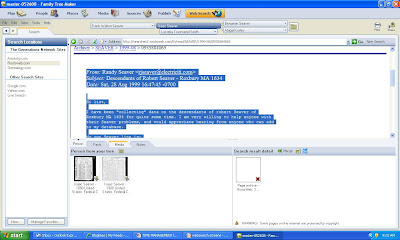
I tried to use the [Edit] menu at the top of the screen, but "Copy" was not available for some reason. So I used "Ctrl-C" to copy the highlighted information to the clipboard. I want to add the highlighted portion in the screen above to my Notes, so I clicked on the Notes tab in the bottom panel, and the notes I already have for Isaac Seaver appeared, as shown in the screen below:
The Notes added were put at the bottom of my previously added Notes, as shown below:
For this part of the series, I'm using my great-great-grandfather, Isaac Seaver (1823-1901), in my database as a starting point for these posts about Web Search.
In the last post, I demonstrated how FTM searches Rootsweb.com (on the left hand panel list of web sites accessible using FTM 2008). In this post, I want to demonstrate using the Web Clipping feature that works with all of the Web Search sites except for Ancestry.com.
In Web Search, with the Rootsweb.com link in the left-hand panel clicked and the mailing list post in the center panel, I clicked on the "Enable Web Clipping" icon (it is the small icon on the far right of the "Search result detail" in the right hand part of the lower panel) - when you enable web clipping, the icon appears in blue with no outline. I also clicked on the "Create Page Archive" icon (just to the left of the "Enable Web Clipping" icon) and a page was put into the "Search result detail" area. Then I highlighted the text of the post in order to use the Web Clipping screen. Before I clicked on Ctrl-C to copy thie highlighted information, the screen looked like this:

I tried to use the [Edit] menu at the top of the screen, but "Copy" was not available for some reason. So I used "Ctrl-C" to copy the highlighted information to the clipboard. I want to add the highlighted portion in the screen above to my Notes, so I clicked on the Notes tab in the bottom panel, and the notes I already have for Isaac Seaver appeared, as shown in the screen below:

Now, I put the cursor in the lower right-hand panel below "Search result detail" and went to Edit>Paste and it added the highlighted text to the lower right-hand panel. I could have done a Ctrl-V to paste the text also. I wonder why the Edit>Copy doesn't work? The screen at this point looks like this:

Now I want to add what is in the "Search result detail" - what I have clipped from the web page, into my Notes in the bottom center panel. To do that, you click on the grenn "Merge" button on the line with "Search result detail." I got this screen with the "Web Merge Wizard" popup box, as shown below:

I clicked "Merge Now" and FTM 2008 told me that my merge of a media item (the web page) and the Notes was successful:

The Notes added were put at the bottom of my previously added Notes, as shown below:

I can not go into that Notes box and move the merged notes to the appropriate location. I have to go back to the [Person] icon and edit the Notes there.
I clicked on the "Media" tab in the bottom panel and the merged web page is shown as a media item there, as shown below:

Unfortunately, the web page image is not shown - an icon is there that shows that a web page is there, but going to the [Media] page and clicking on the merged thumbnail of the web page does not show the image. I may have done something wrong!
The Page Archive Web Clipping is useless unless the actual page gets archived in FTM 2008. I haven't figured out how to do that yet. The Help section says:
"When you have found a page that you want to archive: A group of records, such as a land record archive or death record archive. Click Create page archive. The archive will be saved as a Multipurpose Internet Mail Extension HTML Hypertext Markup Language. The standard language for creating and formatting Web pages. file with a ".mht" extension. This saves all of the components needed to view the file in a single, stand-alone file that you can open in an Internet browser even when you are not connected to the Internet."
I have tried doing exactly that several times and do not get a web page image in the [Media] icon screen.
Frankly, I really don't like using the Web Clipping feature to add text. It would be so much easier to just have my Internet browser open to the web page, highlight the text I want, do an Edit>Copy (or Ctrl-C) and go to my FTM 2008 program [Person] page, open the Notes and do an Edit>Paste (or Ctrl-V) and the text would be in the Notes, and I could edit them there.
The next post will look at using www.Genealogy.com to find information and merge it with a person in the database.
Wednesday, September 10, 2008
Creating a Footnote Page
I just had to try to create a Footnote Page tonight...because I'm really excited by this opportunity. I decided to see what I could find for my grandmother, Emily Kemp (Auble) Carringer (1899-1977). I went to http://www.footnote.com/ and this was the web page screen:
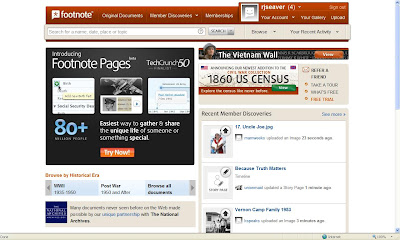
As you can see, "Footnote Pages" is highlighted, so I clicked on the orange "Try Now" button. This screen appeared:
Clicking on the "Save Fact" button takes me back to the Fact Box and now that information has been added to the Page for Emily Kemp (Auble) Carringer, as shown below:

As you can see, "Footnote Pages" is highlighted, so I clicked on the orange "Try Now" button. This screen appeared:

Knowing that Footnote was working from the Social Security Death Index, I put Emily's married name - "Emily Carringer" in the Search box. When I clicked "Search," this screen appeared:

Yep, that's my Gram, born 1899, died 1977. Now - how do I add content? When I run my mouse over any Fact, a green + sign appears to the left of the Fact. In the screen below, I've run the mouse over the Birth Date for Emily.

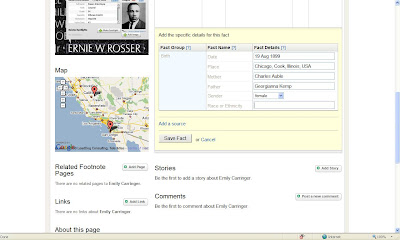
Then I clicked the green plus sign, and this screen comes up. I can add Emily's birth date, birth place, parents names, gender and race/ethnicity in the boxes, as shown below:

Clicking on the "Save Fact" button takes me back to the Fact Box and now that information has been added to the Page for Emily Kemp (Auble) Carringer, as shown below:

I took the opportunity to add the death information for Emily as a Fact, her maiden name (it keeps the name from the SSDI entry, although someone could edit it) , and I added her residence (place, from date, to date, and street address) to the record. Finally, I added a photograph of Emily as a bride in 1918 to her Footnote Page. The resulting page looks like this:

I could add more information to this page - more facts, more photographs, some stories, some comments. I'll do that later.
I still need to figure out how to link her to Lyle Carringer and to her daughter, but I'll save that for tomorrow.
This process is not unlike http://www.geni.com/ and other social network sites. The advantage of Footnote Pages is that it is open to everybody and genealogists will do the editing, writing, adding photos, etc.
UPDATED 9/11: Thanks for the help in Comments, I will go fix things on my Footnote Pages. I guess I could claim that I made the error just to see if anybody reads my blog posts... but no - a real error.
Thomas MacEntee has a similar post at http://destinationaustinfamily.blogspot.com/2008/09/footnotes-new-people-pages.html that goes a little further than this post of mine.
Footnote just got a lot more interesting
I received the email announcement about Footnote's presentation at the TechCrunch 50 conference in San Francisco in email awhile ago. I don't often print a full press release (mainly because someone else beats me to it!) but I haven't seen this posted yet (I know, others probably are posting it as I peck away here). It reads:
--------------------
Footnote.com Takes Social Networking into the Past
Footnote.com launches Footnote Pages at TechCrunch50
San Francisco -- September 10, 2008 Losing a loved one can result in a range of emotions, from the grief and sorrow to comfort, which often comes from reminiscing stories and memories with family and friends. The challenge arises when there is no single place where all of these stories can easily come together to be shared, enriched and preserved.
Now at Footnote.com, anyone can find or create Footnote Pages where users connect and share stories, photos, and information about the people important to them.
To kick-off the new Footnote Pages, Footnote.com today released over 80 million of these pages created from data from the Social Security Death Index. Most visitors will find existing pages about several deceased friends and family members already on the site.
Footnote.com was selected from over 1,000 applicants to launch Footnote Pages at this year’s TechCrunch50 held in San Francisco. Russ Wilding, CEO of Footnote, demonstrated Footnote Pages to an audience of over 1,500 investors, bloggers, and major media outlets.
“We encourage people to upload their personal shoeboxes of photos and documents to Footnote.com,” explains Wilding. “Now with Footnote Pages, friends and family can come together to share stories and memories about the people they care about.”
Described as Facebook for the Deceased, these pages feature a photo gallery, an interactive timeline and map, and other tools that bring people together to create a more colorful and rich picture of the past. “Social networking is not only for the younger generations any more,” explains Wilding. “We are seeing Baby Boomers contribute and connect online in increasing numbers. Footnote Pages are an easy way for this audience to interact with each other and learn things they would not otherwise know about deceased friends and family.”
Beyond profiling people, Footnote pages can also be used to document and discuss historical events or places including: the Vietnam War, the Assassination of JFK and the Lincoln-Douglas Debates.
Unlike other social networking sites, Footnote.com provides content that enables users to tell and share stories from the past. Through its partnership with the National Archives, Footnote.com has digitized over 43 million documents including historical newspapers, military records, photos and more. Footnote.com adds about 2 million new records to the site every month.
Visit Footnote.com to learn more about Footnote Pages and get a new perspective on the lives of your own friends and family who have passed away.
About Footnote.comFootnote.com is a history website where real history might just surprise you. Footnote.com features millions of searchable original documents, providing users with an unaltered view of the events, places and people that shaped the American nation and the world. At Footnote.com, all are invited to come share, discuss, and collaborate on their discoveries with friends, family, and colleagues. For more information, visit www.footnote.com.
About TechCrunch50
Founded in 2007 by leading technology blog TechCrunch and entrepreneur Jason Calacanis, the TechCrunch50 conference provides a platform for early-stage, and frequently unfunded, companies to launch for the first time to the technology industry’s most influential venture capitalists, corporations, angel investors, fellow entrepreneurs, and the international media. Companies are selected to participate exclusively on merit. TechCrunch50 is supported by corporate sponsors Google, Microsoft, MySpace, and Yahoo!, as well as venture capital firms including Sequoia Capital <http://www.sequoiacap.com/>, Mayfield Fund <http://www.mayfield.com>, Clearstone Venture Partners <http://www.clearstone.com>, Charles River Ventures <http://www.crv.com>, Founders Fund and Fenwick & West <http://www.fenwick.com>.###
Footnote.com Contact:
Justin Schroepfer
Marketing Director
(801) 494-6517
Justin@footnote.com
PR Contact:
Jeremy Kartchner
Snapp Conner PR for Footnote.com
(801) 994-9625
jeremy@snappconner.com
--------------------------------------------
This press release has left me genea-smacked for awhile here. I think I understand what they have done and will do, and it sounds exciting to me. Being able to add stories and photos to persons in the Social Security Death Index sounds like a pretty good thing to be able to do. It's social networking and it's genealogy.
What is in the future? My crystal ball is cloudy. If I were doing this, I would invite users (everyone?) to add families for each of their persons in the SSDI. The parents, grandparents, etc., and their children, plus stories and photos. I wonder how much bandwidth that Footnote has? Of course, you are talking about a great number of persons if you go back just two or three generations, but such an undertaking would be a great web-linked family tree, wouldn't it? You would still have the problem of linking different data for the same person together somehow. But if you can just get the "linked family tree" back to about 1850 time frame, it would provide an excellent starting point to go back further.
My compliments to Footnote for their foresight and vision. I think that this may be one of the top genealogy events of 2008.
--------------------
Footnote.com Takes Social Networking into the Past
Footnote.com launches Footnote Pages at TechCrunch50
San Francisco -- September 10, 2008 Losing a loved one can result in a range of emotions, from the grief and sorrow to comfort, which often comes from reminiscing stories and memories with family and friends. The challenge arises when there is no single place where all of these stories can easily come together to be shared, enriched and preserved.
Now at Footnote.com, anyone can find or create Footnote Pages where users connect and share stories, photos, and information about the people important to them.
To kick-off the new Footnote Pages, Footnote.com today released over 80 million of these pages created from data from the Social Security Death Index. Most visitors will find existing pages about several deceased friends and family members already on the site.
Footnote.com was selected from over 1,000 applicants to launch Footnote Pages at this year’s TechCrunch50 held in San Francisco. Russ Wilding, CEO of Footnote, demonstrated Footnote Pages to an audience of over 1,500 investors, bloggers, and major media outlets.
“We encourage people to upload their personal shoeboxes of photos and documents to Footnote.com,” explains Wilding. “Now with Footnote Pages, friends and family can come together to share stories and memories about the people they care about.”
Described as Facebook for the Deceased, these pages feature a photo gallery, an interactive timeline and map, and other tools that bring people together to create a more colorful and rich picture of the past. “Social networking is not only for the younger generations any more,” explains Wilding. “We are seeing Baby Boomers contribute and connect online in increasing numbers. Footnote Pages are an easy way for this audience to interact with each other and learn things they would not otherwise know about deceased friends and family.”
Beyond profiling people, Footnote pages can also be used to document and discuss historical events or places including: the Vietnam War, the Assassination of JFK and the Lincoln-Douglas Debates.
Unlike other social networking sites, Footnote.com provides content that enables users to tell and share stories from the past. Through its partnership with the National Archives, Footnote.com has digitized over 43 million documents including historical newspapers, military records, photos and more. Footnote.com adds about 2 million new records to the site every month.
Visit Footnote.com to learn more about Footnote Pages and get a new perspective on the lives of your own friends and family who have passed away.
About Footnote.comFootnote.com is a history website where real history might just surprise you. Footnote.com features millions of searchable original documents, providing users with an unaltered view of the events, places and people that shaped the American nation and the world. At Footnote.com, all are invited to come share, discuss, and collaborate on their discoveries with friends, family, and colleagues. For more information, visit www.footnote.com.
About TechCrunch50
Founded in 2007 by leading technology blog TechCrunch and entrepreneur Jason Calacanis, the TechCrunch50 conference provides a platform for early-stage, and frequently unfunded, companies to launch for the first time to the technology industry’s most influential venture capitalists, corporations, angel investors, fellow entrepreneurs, and the international media. Companies are selected to participate exclusively on merit. TechCrunch50 is supported by corporate sponsors Google, Microsoft, MySpace, and Yahoo!, as well as venture capital firms including Sequoia Capital <http://www.sequoiacap.com/>, Mayfield Fund <http://www.mayfield.com>, Clearstone Venture Partners <http://www.clearstone.com>, Charles River Ventures <http://www.crv.com>, Founders Fund and Fenwick & West <http://www.fenwick.com>.###
Footnote.com Contact:
Justin Schroepfer
Marketing Director
(801) 494-6517
Justin@footnote.com
PR Contact:
Jeremy Kartchner
Snapp Conner PR for Footnote.com
(801) 994-9625
jeremy@snappconner.com
--------------------------------------------
This press release has left me genea-smacked for awhile here. I think I understand what they have done and will do, and it sounds exciting to me. Being able to add stories and photos to persons in the Social Security Death Index sounds like a pretty good thing to be able to do. It's social networking and it's genealogy.
What is in the future? My crystal ball is cloudy. If I were doing this, I would invite users (everyone?) to add families for each of their persons in the SSDI. The parents, grandparents, etc., and their children, plus stories and photos. I wonder how much bandwidth that Footnote has? Of course, you are talking about a great number of persons if you go back just two or three generations, but such an undertaking would be a great web-linked family tree, wouldn't it? You would still have the problem of linking different data for the same person together somehow. But if you can just get the "linked family tree" back to about 1850 time frame, it would provide an excellent starting point to go back further.
My compliments to Footnote for their foresight and vision. I think that this may be one of the top genealogy events of 2008.
Subscribe to:
Posts (Atom)