The latest issue of UpFront (the National Genealogical Society email newsletter) has the following announcement:
------------------------------------
The National Genealogical Society announced several new and revised publications from its Research in the States Series just before the 2007 Conference in the States, and the books fairly flew off the shelves.
Several were sell-outs, so we want to make sure everyone knows that the e-book versions are available right now from the NGS web site. Each publication includes a section on archives, libraries, societies, and other research facilities in the respective state, as well as a discussion of the major family history resources available, such as maps, cemetery records, census, city directories, newspapers, military records, tax records and vital records. In addition each state includes a discussion of which records are available at the local, county, andstate level.
Series Editors, Ann Carter Fleming and Kay Haviland Freilich worked with various authors to update the research in some states and complete research on new states. The new and revised publications are as follows:
* Genealogical Research in Illinois by Diane Renner Walsh (published in the NGS Quarterly in 2006, now available as a separate publication)
* Genealogical Research in Maryland by Patricia O'Brien Shawker (new, never published)
* Genealogical Research in Missouri by Pamela Boyer Porter and Ann Carter Fleming (revised and updated from 1999)
* Genealogical Research in Oregon by Connie Miller Lenzen (revised and updated from 1992)
* Genealogical Research in Pennsylvania by Kay Haviland Freilich (revised and updated from 2003)
* Genealogical Research in Virginia by Eric G. Grundset (revised and updated from 1998)
* Genealogical Research in West Virginia by Barbara Vine Little (new, never published)
Each publication is 8 1/2 inches by 11 inches, slightly larger than our previous Research in the States publications. The average length is 42 pages, but it varies by state. Each is currently available as a PDF file, an "e-book" that you can download from the NGS web site and then either read on your computer or print. Prices are $8 for NGS members and 10$ for non-members.
The direct link to the download and purchase page is https://www.ngsgenealogy.org/bookstore/ListItems.cfm?CATID=32 For those who prefer to purchase printed copies, watch for an announcement on the website as soon as we've replenished our inventory.
NGS and Editors Fleming and Freilich are working on several more states, especially those hosting future Conferences in the States and surrounding states.
"Originally published in UpFront with NGS, The Online Newsletter of theNational Genealogical Society. http://www.NGSgenealogy.org/upfront.htm"
--------------------------------------------
If you have an interest in these 7 states, these E-books may be very helpful in your research. Several of them have been published previously in the NGS Quarterly previously.
We can never have too much information!
Wednesday, August 1, 2007

Tuesday, July 31, 2007
Norman Seaver (1734-1787) died 220 years ago today
One of my favorite ancestors , especially in my Seaver ancestry, is Norman Seaver. He died on 31 July 1787 in Westminster, Worcester County, Massachusetts. Here is his story (from my database):
===================================
NORMAN5 SEAVER (ROBERT4, JOSEPH3, SHUBAEL2, ROBERT1) was born about 1734 in Framingham, Middlesex, MA, (age 53 at death), and died 31 July 1787 in Westminster, Worcester, MA, (VR, 247). He married SARAH READ 14 March 1755 in Sudbury, Middlesex, MA, (VR, 265), daughter of ISAAC READ and EXPERIENCE WILLIS. She was born 28 December 1736 in Sudbury, Middlesex, MA, (VR, 2118), and died before 3 January 1809 in Westminster, Worcester, MA, ( PR).
Norman Seaver was born about 1734 or 1735, according to his age 53 (on his gravestone) at the time of his death in 1787 in Westminster.
He went to Narragansett No. 2 (later Westminster) in 1750 with his father, and money was paid to him by the town proprietors in 1751. After the death of his father in 1752, he probably lived in Sudbury or Framingham with his mother. After he married in 1755, he lived in Sudbury where three children were born, and moved to Shrewsbury in 1760. Six children were registered there, and he moved to Westminster (formerly Narragansett No. 2) in 1773, purchasing lots 76 and 122 of the 3rd division from Heman Kendall; the property was between Prospect Hill and Beech Hill [Heywood, "History of Westminster, Mass.", Lowell MA, Vox Populi Press, 1893, hereafter "Heywood)].
Norman Seaver, husbandman of Sudbury, bought 100 acres of land in Shrewsbury for 120 pounds on 15 September 1760 from Edward Raymond of Shrewsbury [Worcester County Deeds 47.97, recorded 2 May 1762, LDS Microfilm 0,843,179].
Norman Seaver of Shrewsbury sold 15 acres of land in Shrewsbury, at the northeast corner of Maldin farm, on 14 January 1769 to Isaac Temple of Shrewsbury for 15 pounds. The land was bounded by land of Isaac Temple (east and west) and Norman Seaver (north and south) [Worcester County Deeds 72.84, recorded 8 December 1773, LDS Microfilm 0,843,358].
Norman Sever, yeoman of Shrewsbury, bought 1 acre in Shrewsbury on 8 April 1772 for 2 pounds from Thomas Andrews, gentleman of Shrewsbury. The land was a triangular piece, bounded by land of Norman Sever, Thomas Andrews and Philip Munroe [Worcester County Deeds 77.47, recorded 3 May 1777, LDS Microfilm 0,843,360].
Norman Sever, yeoman of Shrewsbury, sold land in Shrewsbury to Abel Osgood of Rutland on 22 April 1772 for 200 pounds, 13 shillings, 4 pence [Worcester County Deeds 87.158, recorded 10 December 1782, LDS Microfilm 0,843,364].
Norman Sever, yeoman of Westminster, bought 127 acres of land in the northerly part of Westminster from Heman Kendall, yeoman of Lancaster, on 12 May 1773. It included 2/3 of lot 76, lot 125, part of lot 65, and another 3rd division lot; this land bounded land of Edward Jackson, Amos Gates, Joseph Spaulding, Asa Taylor and Wheeler [Worcester County Deeds 74.142, recorded 12 August 1774, LDS film 0,843,359].
Norman Sever, yeoman of the county of Worcester, sold 5 acres 100 rods of land in the northerly part of Westminster to Joseph Spaulding, housewright of Westminster, for 10 pounds on 5 July 1776. The land was taken from the southeast corner of the Second Division lot No. 250, and was bounded by a maple tree, stakes and stones, and land of Joseph Spaulding [Worcester County Deeds 77.35, recorded 28 April 1777, LDS Microfilm 0,843,560].
He also bought a different 5 acres and 100 rods of land in the northerly part of Westminster from Joseph Spaulding for 10 pounds. The land was bounded by stakes and stones [Worcester County Deeds 76.148, recorded 5 August 1777, LDS Microfilm 0,843,360].
Norman Sever, yeoman of Shrewsbury, bought land in the northerly part of Westminster from Thomas Farnsworth of Westminster for 18 pounds on 25 December 1782 [Worcester County Deeds 87.228, recorded 7 February 1783, LDS Microfilm 0,843,364].
Norman Seaver, gentleman of Westminster, sold about 3/4 acre of land in the Beech Hill meadow in the northeasterly part of Westminster to Amos Gates for 2 pounds, 5 shillings on 8 March 1784. The land was in the southwest corner of meadow number 40, and was bounded by lot 41, land of Norman Seaver and Amos Gates [Worcester County Deeds 91.476, recorded 8 July 1784, LDS Microfilm 0,843,366].
Norman Seaver, and several of his sons, served in the Revolutionary War. He was a Sergeant in Captain Noah Miles company that marched on the alarm of April 19, 1775 to Cambridge and joined Colonel John Whitcomb's regiment there for eleven and one half days of service. He was reported as not having enlisted into the army. He served as an Ensign in Captain Francis Willson's company in Colonel Danforth Keyes regiment from June 27 to July 27, 1777, with the roll dated Providence; he served in the same company and regiment from December 1, 1777 to January 3, 1778, with the roll dated Providence. As a First Lieutenant in Captain Ebenezer Belknap's company in Colonel Nathaniel Wade's regiment, he was engaged on April 1, 1778 and discharged January 3, 1779, serving in Rhode Island. Muster rolls dated North Kingston, Rhode Island were taken on November 6 and December 1, 1778, and muster rolls at East Greenwich, Rhode Island were dated September 28, November 6, November 10, December 1, and December 30, 1778, with his term to expire on January 1, 1779. Several other Westminster men, probably sons of Norman Seaver, who served in the Revolutionary War were Benjamin, Joseph, and Isaac Seaver. In addition, Norman's brothers, Moses Seaver and Samuel Seaver of Westminster, served ["Massachusetts Soldiers and Sailors of the Revolutionary War", Volume XII, pub. Boston, 1905, p. 1006].
Norman Seaver may have been commissioned as Captain of the Militia after the Revolutionary War ended, since he is styled Captain on his death record and his gravesite in Woodside Cemetery in Westminster.
Norman Seaver is listed as the holder of Pew No. 2 on the lower floor near the wall of the Second Meetinghouse. The pew cost between $31 to $66 [Heywood].
Norman Seaver was a carpenter by trade. He took a contract for enclosing and shingling on the second meetinghouse of the town. During the raising of the building he fell from the frame receiving fatal injuries [Heywood].
Norman Seaver, gentleman of Westminster, died intestate. His probate docket [Worcester County Probate Records, Probate Packet 52,914] includes the following documents:
On 25 Sep 1787, Widow Sarah Sever was appointed administratrix of the estate, and bond in the amount of 2000 pounds was given by William Edgell, and Josiah Puffer, sureties [Worcester County Probate Records, 179.530, LDS Microfilm 0,860,627]. On 28 Sep 1787 a Warrant of Appraisal was given for an inventory to be taken. [Worcester County Probate Records, 21.487, LDS Microfilm 0,856,285]. On 21 Oct 1788 the Account Balance of 150 pounds 19 shillings was allowed [Worcester County Probate Records, 22.139, LDS Microfilm 0,856,286].
On 21 Oct 1788 a Warrant for partition of the estate was issued to William Edgell, Josiah Puffer and Edward Jackson [Worcester County Probate Records, 24.263, LDS Microfilm 0,856,314]. They found the home place with buildings and land comprised 106 acres lying in Westminster. An additional 3 acres were held in common with Timothy Heywood, Samuel Miller, and William Murdock, all of Westminster. In 1791, the inventory was recorded, with Real estate 215 pounds and personal estate of 159 pounds, 19 shillings and 9 pence. The real estate included the 106 acre house lot with buildings (212 pounds) and a piece of land in common with Timothy Heywood and Samuel ??? and William Murdock (3 pounds) [Worcester County Probate Records, 24.370, LDS Microfilm 0,856,314].
On 3 Jan 1792, the Account balance of 3 pounds, 13 shillings and 9 pence was allowed and distribution to the heirs was ordered [Worcester County Probate Records, 24.358, LDS Microfilm 0,856,314]. Heirs named in the distribution are:
· widow Sarah Seaver (1/3 dower right)
· son Benjamin Sever (2/3 real estate + double portion)
· son Isaac Sever,
· son Ethan Sever,
· son Daniel Sever,
· son Heman Sever,
· son Luther Sever,
· son Asel Sever,
· daughter Eunice Whitney (wife of Elisha Whitney)
· daughter Sarah Cutter (wife of Josiah Cutter),
· daughter Relief Sever,
· daughter Faithfull Sever,
· daughter Lucinda Sever
In the distribution, the eldest son, Benjamin Sever, was awarded his double portion of 22 pounds and was ordered to pay the other children their equal share of 11 pounds each. [Worcester County Probate Records, 24.358, LDS Microfilm 0,856,314].
Norman Seaver's grave is located in the western end of Woodside Cemetery in Westminster MA. There is a rough hewn stone with his name on it, and several smaller unmarked stones in the same plot. The Sons of the American Revolution (SAR) have erected a new stone to commemorate his service in the Revolutionary War.
Notes for Sarah Read:
On 3 January 1792, Sarah Seaver was appointed guardian for daughters Feathe and Lucenden Seaver, while Samuel Gerrish was appointed guardian for Asel and Relief Seaver [Worcester County Probate Records, Probate Packet 52,863].
In the 1790 U.S. census, Sarah Seaver was living in Westminster with 6 white females and one free white male under age 16. [Worcester County MA 1790 US census, LDS Microfilm 0,568,144, page 243].
In the 1800 census, Sarah Seaver is probably included in the census record for her son, Benjamin Severs of Westminster [Worcester County MA 1800 US Census, LDS Microfilm 0,205,617, Page 451].
The estate of widow Sarah Seaver [Worcester County Probate Records, Probate Packet 52924], who died intestate, probably in late 1808, indicates that on 3 January 1809 Benjamin Sever was appointed administrator of the estate, and bond of $10,000 was given by Benjamin Seaver, Heman Ray, and Daniel How, all yeomen of Westminster [Worcester County Probate Records, 171.328, LDS Microfilm 0,860,623]. On 3 January 1809, a warrant of appraisal was granted [Worcester County Probate Records, 623:194]. On 1 November 1809, the inventory was recorded with real property of $450 and a personal estate of $63 [Worcester County Probate Records, 38:152, LDS Microfilm 0,856,321].
===================================
===================================
NORMAN5 SEAVER (ROBERT4, JOSEPH3, SHUBAEL2, ROBERT1) was born about 1734 in Framingham, Middlesex, MA, (age 53 at death), and died 31 July 1787 in Westminster, Worcester, MA, (VR, 247). He married SARAH READ 14 March 1755 in Sudbury, Middlesex, MA, (VR, 265), daughter of ISAAC READ and EXPERIENCE WILLIS. She was born 28 December 1736 in Sudbury, Middlesex, MA, (VR, 2118), and died before 3 January 1809 in Westminster, Worcester, MA, ( PR).
Norman Seaver was born about 1734 or 1735, according to his age 53 (on his gravestone) at the time of his death in 1787 in Westminster.
He went to Narragansett No. 2 (later Westminster) in 1750 with his father, and money was paid to him by the town proprietors in 1751. After the death of his father in 1752, he probably lived in Sudbury or Framingham with his mother. After he married in 1755, he lived in Sudbury where three children were born, and moved to Shrewsbury in 1760. Six children were registered there, and he moved to Westminster (formerly Narragansett No. 2) in 1773, purchasing lots 76 and 122 of the 3rd division from Heman Kendall; the property was between Prospect Hill and Beech Hill [Heywood, "History of Westminster, Mass.", Lowell MA, Vox Populi Press, 1893, hereafter "Heywood)].
Norman Seaver, husbandman of Sudbury, bought 100 acres of land in Shrewsbury for 120 pounds on 15 September 1760 from Edward Raymond of Shrewsbury [Worcester County Deeds 47.97, recorded 2 May 1762, LDS Microfilm 0,843,179].
Norman Seaver of Shrewsbury sold 15 acres of land in Shrewsbury, at the northeast corner of Maldin farm, on 14 January 1769 to Isaac Temple of Shrewsbury for 15 pounds. The land was bounded by land of Isaac Temple (east and west) and Norman Seaver (north and south) [Worcester County Deeds 72.84, recorded 8 December 1773, LDS Microfilm 0,843,358].
Norman Sever, yeoman of Shrewsbury, bought 1 acre in Shrewsbury on 8 April 1772 for 2 pounds from Thomas Andrews, gentleman of Shrewsbury. The land was a triangular piece, bounded by land of Norman Sever, Thomas Andrews and Philip Munroe [Worcester County Deeds 77.47, recorded 3 May 1777, LDS Microfilm 0,843,360].
Norman Sever, yeoman of Shrewsbury, sold land in Shrewsbury to Abel Osgood of Rutland on 22 April 1772 for 200 pounds, 13 shillings, 4 pence [Worcester County Deeds 87.158, recorded 10 December 1782, LDS Microfilm 0,843,364].
Norman Sever, yeoman of Westminster, bought 127 acres of land in the northerly part of Westminster from Heman Kendall, yeoman of Lancaster, on 12 May 1773. It included 2/3 of lot 76, lot 125, part of lot 65, and another 3rd division lot; this land bounded land of Edward Jackson, Amos Gates, Joseph Spaulding, Asa Taylor and Wheeler [Worcester County Deeds 74.142, recorded 12 August 1774, LDS film 0,843,359].
Norman Sever, yeoman of the county of Worcester, sold 5 acres 100 rods of land in the northerly part of Westminster to Joseph Spaulding, housewright of Westminster, for 10 pounds on 5 July 1776. The land was taken from the southeast corner of the Second Division lot No. 250, and was bounded by a maple tree, stakes and stones, and land of Joseph Spaulding [Worcester County Deeds 77.35, recorded 28 April 1777, LDS Microfilm 0,843,560].
He also bought a different 5 acres and 100 rods of land in the northerly part of Westminster from Joseph Spaulding for 10 pounds. The land was bounded by stakes and stones [Worcester County Deeds 76.148, recorded 5 August 1777, LDS Microfilm 0,843,360].
Norman Sever, yeoman of Shrewsbury, bought land in the northerly part of Westminster from Thomas Farnsworth of Westminster for 18 pounds on 25 December 1782 [Worcester County Deeds 87.228, recorded 7 February 1783, LDS Microfilm 0,843,364].
Norman Seaver, gentleman of Westminster, sold about 3/4 acre of land in the Beech Hill meadow in the northeasterly part of Westminster to Amos Gates for 2 pounds, 5 shillings on 8 March 1784. The land was in the southwest corner of meadow number 40, and was bounded by lot 41, land of Norman Seaver and Amos Gates [Worcester County Deeds 91.476, recorded 8 July 1784, LDS Microfilm 0,843,366].
Norman Seaver, and several of his sons, served in the Revolutionary War. He was a Sergeant in Captain Noah Miles company that marched on the alarm of April 19, 1775 to Cambridge and joined Colonel John Whitcomb's regiment there for eleven and one half days of service. He was reported as not having enlisted into the army. He served as an Ensign in Captain Francis Willson's company in Colonel Danforth Keyes regiment from June 27 to July 27, 1777, with the roll dated Providence; he served in the same company and regiment from December 1, 1777 to January 3, 1778, with the roll dated Providence. As a First Lieutenant in Captain Ebenezer Belknap's company in Colonel Nathaniel Wade's regiment, he was engaged on April 1, 1778 and discharged January 3, 1779, serving in Rhode Island. Muster rolls dated North Kingston, Rhode Island were taken on November 6 and December 1, 1778, and muster rolls at East Greenwich, Rhode Island were dated September 28, November 6, November 10, December 1, and December 30, 1778, with his term to expire on January 1, 1779. Several other Westminster men, probably sons of Norman Seaver, who served in the Revolutionary War were Benjamin, Joseph, and Isaac Seaver. In addition, Norman's brothers, Moses Seaver and Samuel Seaver of Westminster, served ["Massachusetts Soldiers and Sailors of the Revolutionary War", Volume XII, pub. Boston, 1905, p. 1006].
Norman Seaver may have been commissioned as Captain of the Militia after the Revolutionary War ended, since he is styled Captain on his death record and his gravesite in Woodside Cemetery in Westminster.
Norman Seaver is listed as the holder of Pew No. 2 on the lower floor near the wall of the Second Meetinghouse. The pew cost between $31 to $66 [Heywood].
Norman Seaver was a carpenter by trade. He took a contract for enclosing and shingling on the second meetinghouse of the town. During the raising of the building he fell from the frame receiving fatal injuries [Heywood].
Norman Seaver, gentleman of Westminster, died intestate. His probate docket [Worcester County Probate Records, Probate Packet 52,914] includes the following documents:
On 25 Sep 1787, Widow Sarah Sever was appointed administratrix of the estate, and bond in the amount of 2000 pounds was given by William Edgell, and Josiah Puffer, sureties [Worcester County Probate Records, 179.530, LDS Microfilm 0,860,627]. On 28 Sep 1787 a Warrant of Appraisal was given for an inventory to be taken. [Worcester County Probate Records, 21.487, LDS Microfilm 0,856,285]. On 21 Oct 1788 the Account Balance of 150 pounds 19 shillings was allowed [Worcester County Probate Records, 22.139, LDS Microfilm 0,856,286].
On 21 Oct 1788 a Warrant for partition of the estate was issued to William Edgell, Josiah Puffer and Edward Jackson [Worcester County Probate Records, 24.263, LDS Microfilm 0,856,314]. They found the home place with buildings and land comprised 106 acres lying in Westminster. An additional 3 acres were held in common with Timothy Heywood, Samuel Miller, and William Murdock, all of Westminster. In 1791, the inventory was recorded, with Real estate 215 pounds and personal estate of 159 pounds, 19 shillings and 9 pence. The real estate included the 106 acre house lot with buildings (212 pounds) and a piece of land in common with Timothy Heywood and Samuel ??? and William Murdock (3 pounds) [Worcester County Probate Records, 24.370, LDS Microfilm 0,856,314].
On 3 Jan 1792, the Account balance of 3 pounds, 13 shillings and 9 pence was allowed and distribution to the heirs was ordered [Worcester County Probate Records, 24.358, LDS Microfilm 0,856,314]. Heirs named in the distribution are:
· widow Sarah Seaver (1/3 dower right)
· son Benjamin Sever (2/3 real estate + double portion)
· son Isaac Sever,
· son Ethan Sever,
· son Daniel Sever,
· son Heman Sever,
· son Luther Sever,
· son Asel Sever,
· daughter Eunice Whitney (wife of Elisha Whitney)
· daughter Sarah Cutter (wife of Josiah Cutter),
· daughter Relief Sever,
· daughter Faithfull Sever,
· daughter Lucinda Sever
In the distribution, the eldest son, Benjamin Sever, was awarded his double portion of 22 pounds and was ordered to pay the other children their equal share of 11 pounds each. [Worcester County Probate Records, 24.358, LDS Microfilm 0,856,314].
Norman Seaver's grave is located in the western end of Woodside Cemetery in Westminster MA. There is a rough hewn stone with his name on it, and several smaller unmarked stones in the same plot. The Sons of the American Revolution (SAR) have erected a new stone to commemorate his service in the Revolutionary War.
Notes for Sarah Read:
On 3 January 1792, Sarah Seaver was appointed guardian for daughters Feathe and Lucenden Seaver, while Samuel Gerrish was appointed guardian for Asel and Relief Seaver [Worcester County Probate Records, Probate Packet 52,863].
In the 1790 U.S. census, Sarah Seaver was living in Westminster with 6 white females and one free white male under age 16. [Worcester County MA 1790 US census, LDS Microfilm 0,568,144, page 243].
In the 1800 census, Sarah Seaver is probably included in the census record for her son, Benjamin Severs of Westminster [Worcester County MA 1800 US Census, LDS Microfilm 0,205,617, Page 451].
The estate of widow Sarah Seaver [Worcester County Probate Records, Probate Packet 52924], who died intestate, probably in late 1808, indicates that on 3 January 1809 Benjamin Sever was appointed administrator of the estate, and bond of $10,000 was given by Benjamin Seaver, Heman Ray, and Daniel How, all yeomen of Westminster [Worcester County Probate Records, 171.328, LDS Microfilm 0,860,623]. On 3 January 1809, a warrant of appraisal was granted [Worcester County Probate Records, 623:194]. On 1 November 1809, the inventory was recorded with real property of $450 and a personal estate of $63 [Worcester County Probate Records, 38:152, LDS Microfilm 0,856,321].
===================================
Using AncestryPress to Create a Book
I posted here about my experiences in uploading data to http://www.ancestry.com Personal Member Tree database. The data I uploaded was from my Seaver database, which is intended as a Descendants project and not an Ancestors project.
At the time, I tried to create a Family History Book from the uploaded data just to see the product of the Beta software called AncestryPress.
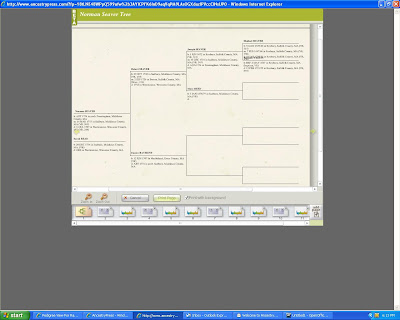
I won't go into all of the steps I used, but I will show the product of my efforts. To start the Family Book creation process, you have to select someone from your database. In this case, I selected Norman Seaver (1734-1787) while in my Member Tree project. Then I clicked the link for "Publish and Print From Home (BETA)." That took me into the http://www.ancestrypress.com/ software and I created the Family Book there using the first choice offered -
* Make a family history book from templates. Ancestry Press will automatically gather information, records and images from your Ancestry.com family tree and compile them using professionally designed templates.
When you press the button to create the Family Book from the templates, you eventually get three types of pages that look like this:
1. A Pedigree Chart for your target person - in my case, Norman Seaver.
2. A Family Group Sheet for the Norman Seaver family.
At the time, I tried to create a Family History Book from the uploaded data just to see the product of the Beta software called AncestryPress.
I won't go into all of the steps I used, but I will show the product of my efforts. To start the Family Book creation process, you have to select someone from your database. In this case, I selected Norman Seaver (1734-1787) while in my Member Tree project. Then I clicked the link for "Publish and Print From Home (BETA)." That took me into the http://www.ancestrypress.com/ software and I created the Family Book there using the first choice offered -
* Make a family history book from templates. Ancestry Press will automatically gather information, records and images from your Ancestry.com family tree and compile them using professionally designed templates.
When you press the button to create the Family Book from the templates, you eventually get three types of pages that look like this:
1. A Pedigree Chart for your target person - in my case, Norman Seaver.

2. A Family Group Sheet for the Norman Seaver family.

3. A Timeline for Norman Seaver's life.

This sequence is repeated for generation on the Pedigree Chart - there is a Family Group Sheet for every family, and a Timeline for every person on the Pedigree Chart. It creates four generations of pictures similar to those above. If a four generation pedigree chart was completely filled out, there would be 8 Family Group Sheets and 17 Timelines - or a total of 26 charts in the Family Book (counting the Pedigree Chart).
There is the opportunity to add more charts by picking another target person and repeating the process.
I can save the Family Book to my Ancestry Projects, and I can print it out page-by-page, but I couldn't find a way to download it to my computer.
Yes, there is a lot of gray space on the computer screen when you see the book pages. However, when you click on Print Preview, you get a full screen of useful information, and the print is only of the page with information on it.
Frankly, this is not what I expected when I read the AncestryPress description the first time. I thought that I would be able to create an Ahnentafel Report or a Descendants Report, for however many generations I chose, including notes, sources, charts and pictures.
We don't always get what we expect!
However, there was another option back at the beginning of the Family Book creation. I could have chosen the option to -
* Or make a family history book from scratch. Create pages one at a time from scratch or choose from professionally designed templates provided.
When I select that option, I get a blank page. I can add more pages if I want to. Then I can select a person in my database (in this case, Norman Seaver), and icons for the vital records (birth, marriage, death) and my Notes (hey, my notes did get uploaded!) appear at the top of the screen. I can then drag and drop any of the icons onto the page in any order I desire. However, when I drag and drop my Notes, they are too long for the page. I couldn't figure out how to cut them apart and put them on the next page in the Family Book.
You can do this last process as many times as you want for as many persons as you want - but there is no automatic way to do it for "all of the ancestors of ..." or "all of the descendants of ..."
This Family Book creator is still in Beta. They will eventually add the Photo Tree (a picture for each person) and Combination Tree (four generations of husband and wife with children) as time goes on.
As they continue to develop the software, I think that AncestryPress should create a Notes page with Sources for each family as a standard Book chart. The user can always delete it if s/he doesn't want it. A page like this should enable all of the Notes to be shown, even if it takes more than one page per person.
While this AncestryPress product may be impressive to people who have never worked with genealogy software before, my opinion is that it is not very useful to someone like me with software. I can generate a ahnentafel or descendants report with sources, plus pedigree and family group charts, and put them into a publishable book with just a few keystrokes in my genealogy software.
UPDATED 7/31, 10:30 PM. Corrected errors, added text for accuracy and clarity.
What Should Genealogy Society Blogs Publish?
When the Chula Vista Genealogical Society started the Chula Vista Genealogy Cafe blog earlier this year, the CVGS Board of Directors discussed what the content should be. We decided the intent of the blog should be to publicize society activities, encourage our members to read the blog for current genealogy news, and try to connect online researchers to our members by sharing genealogy information.
In the beginning, we decided that the content should include:
* Meeting and Program notices - to inform local genealogists of the society activities, and attempt to draw new members.
* Meeting and Program summaries - same reason as above, and to serve as a draft for the society newsletter.
* Posts or articles about local genealogy repositories
* Posts or articles about genealogy resources - both traditional and online
* Articles or stories about research problems, research trips and success stories by members.
This has worked fairly well so far, at least as far as publicizing the society activities go. Only a few CVGS members read the blog regularly, although most have visited it at least once.
What else could the CVGS blog post? We have thought of the following:
* Family Bible records in the possession of society members
* Family papers with genealogical data in the possession of society members.
* Ahnentafels of society members (perhaps limited to 6 or 7 generations).
* Biographies of ancestors of society members - especially elusive or "brick-wall" ancestors.
* Lists of the loose collections of newsletters, periodicals and family papers in the society file drawers.
* Cemetery gravestone readings or sexton records
* Lists of newspaper obituaries
The reasoning for the above is to try to publicize holdings in private hands or society hands so that it might help other researchers. For example, I have three family Bibles and several family papers containing genealogy data from distant localities that might be helpful to other researchers. If I post them on a society blog, other researchers might find them in using a Search Engine. Frankly, they have little value sitting in a cramped file cabinet at a library or other repository, even if there is a card file index of the society holdings.
All of the items above should also be put onto a society web site for permanent retention. The key, in my opinion, is to put as much information online, that might be helpful to other researchers, as possible.
In all of the above, the privacy of society members should be protected by not publishing information about living people.
We would love to have your ideas on what else could be added to the CVGenCafe blog content.
There are a number of genealogical and historical societies now publishing blogs - you can find an updated list at Chris Dunham's Genealogy Blog Finder web site - the Association and Societies listing is here.
Local Society Publications can be a Goldmine
Whenever I travel to an ancestral place, I try to visit the local library, genealogical society and historical society to try to find records that are not available anywhere else. My experience is that documents in these repositories can provide unique records that break down brick wall problems. The problem is finding them!
As a good example -- my San Diego Genealogical Society (SDGS) publishes a quarterly called San Diego Leaves and Saplings. They published the 35th volume in 2007 - this volume has 164 pages of data extracted from San Diego County records. The tables of contents are below:
Volume 35, No. 1 (Jan - Mar 2007):
* In the News -- From San Diego -- page 2
* Silas STEVENS and Irene TRACY Family Bible Record -- page 5
* Index to 1932 Great Register, San Diego County, CA - Carlsbad Precinct No. 1 -- page 9
* Index to 1932 Great Register, San Diego County, CA - Carlsbad Precinct No. 2 -- page 16
* San Diego County Hospital Records, 1925 (continued) -- page 23
Volume 35, No. 2 (Apr - Jun 2007):
* In the News -- From San Diego -- page 42
* Robert E. MILLER Family Bible -- page 45
* Applications and Consents of Parents for Marriage, 1868-1869 -- page 50
* San Diego County Hospital Records, 1925 (continued) -- page 57
Volume 35, No. 3 (Jul - Sep 2007):
* In the News -- From San Diego -- page 82
* Franklin V. CROUCH and Mary Emily "Mollie" MILLER Family Bible -- page 85
* Indigent Register for the County of San Diego, 1891-1894 -- page 90
* BUTLER Family Record -- page 95
* San Diego County Hospital Records, 1925 (continued) -- page 97
Volume 35, No. 4 (Oct - Dec 2007):
* In the News -- From San Diego -- page 122
* Samuel CLARK Family Bible -- page 125
* Marriage Licenses and Certificates, 1880 - 1881 -- page 130
* Marcus Schiller - "The Jewish Horatio Alger of Old Town" by Bob Wohl -- page 132
* San Diego County Hospital Records, 1925 (continued) -- page 134
* Volume 35 (2007) SURNAME Index -- page 151
Fortunately, San Diego Leaves and Saplings is included in the PERiodical Source Index (PERSI) so that knowledgeable researchers can find a reference to records like these. SDGS has put their Tables of Contents online at http://www.rootsweb.com/~casdgs/leaves/index.html. A Google (or other search engine) search will find them if the correct phrase is used.
SDGS has also collected data on many specific topics and put them into publications. A Google (or other search engine) search will find them if the correct phrase is used.
SDGS provides a search box for San Diego Leaves and Saplings, but it finds only the Table of Contents words and not items from the Surname Index in each volume. There are Surname Indexes for all 35 volumes. A researcher has to find a repository with the published volumes and search each Surname Index in order to find their research targets.
In San Diego County, the complete 35 volumes can be found at the Carlsbad Georgina Cole Library, the Chula Vista Civic Center Library, the Escondido Library Pioneer Room, the San Diego Public Library (downtown), and San Diego Genealogical Society library in El Cajon, and the San Diego Regional Family History Center in Mission Valley. A complete list of repositories with complete or partial holdings is found at http://www.rootsweb.com/~casdgs/leaves/holdings.htm.
The current editor of San Diego Leaves and Saplings is Marna L. Clemons. She is aided by a staff of nine dedicated genealogists. Subscriptions to this publication are $15 per year. You can get more information at the SDGS web site.
Monday, July 30, 2007
Diane Godinez' talk on "Researching Hispanic Family History"
The Chula Vista Genealogical Society program today was on "Researching Hispanic Family History" by Diane Godinez. Diane's biography and talk summary are posted here. I was really looking forward to her presentation because it provides an opportunity to better understand this area of genealogy research which applies to about 50% of our local population.
Perhaps the most useful information she passed on was the naming system used for many centuries in Hispanic families. A person has a first given name, perhaps a second given name, and then two surnames - the first is the father's father's surname and the second is the mother's father's surname. The wife retains her father's surname in her identity. The children of the family are called by the father's surname. For instance, Maria Barragan Gutierrez has a given name of Maria, her father's surname was Barragan, her mother's surname was Gutierrez, and she was known in public as Maria Barragan. If she married Jose Garcia Ramirez and they had a child Pablo, the child's name would have been Pablo Garcia Barragan. It's a really simple and useful system, but confusing to English speaking Americans who often use the "last name" when referring to people of Hispanic heritage.
Diane works at the Bonita FHC and has compiled a list of Mexican church records available at the Center on microfilm, which we will soon post on the CVGS web site. She noted that Mexican church records were the most useful documents available for pre-1900 records, and many church records are available on microfilm from the LDS Family History Library Catalog. The church records contain baptisms (often immediately after birth, with godparents who are usually family members), marriages (they usually list the birth places and birth parents of each person), and deaths (which list the parents for a child, the spouse for a married adult). Since many Mexican church records have been extracted into the LDS IGI, once you find an event in a certain church, you can usually use the Batch Number to find the entire set of extracted records and find other family members.
She said that the 1930 census for Mexico is the only useful census data, and provided an example of the information enumerated. She also mentioned Civil Registration, which is a more recent birth, marriage or death record filed with the state.
Diane was asked about the coverage of Mexican church records in the LDS microfilms, and said that very many churches had their records microfilmed, but that they were not complete. Her example for a small village church in Jalisco had records from 1699 to 1958. You really have to consult the Family History Library Catalog for a specific village or city.
She provided a number of references, including:
* "Spanish Records Extraction - An Instructional Guide" available online for download at http://immigrants.byu.edu/Downloads/Spanish_Extraction_Guide/Default.htm.
* Al's Genealogy at http://alsgenealogy.com/ - an excellent introduction to Hispanic Family History research.
* http://www.somosprimos.com/ - provides information on many research areas and different countries. There are links to 8 years of Society of Hispanic Historic and Ancestral Research (SHHAR) monthly publications with significant genealogy content.
* http://nuestrosranchos.com/ - for researchers of Jalisco, Zacatecas and Aguascalientes families.
Diane's talk was a great eye-opener for our members, interesting and intriguing, and fun. At the very least, now our CVGS members know a bit more about Hispanic research and have someone that we can direct local Hispanic families to for expert help.
Della's Journal - Week 31 (30 July to 5 August 1929)
This is Installment 31 of the Journal of Della (Smith) Carringer, my great-grandmother, who resided at 2115 30th Street in San Diego in 1929.
The "players" and "setting" are described here. Pictures of some of the players are here. Last week's Journal entry is here.
Here is Week 31:
====================================
Tuesday, July 30: Betty's Birthday, ten years old today. Lyle got her Kodack. Cousin Bessie & Vernon gave her Piano bench that holds music. Mrs. A[uble] gave her doll & paper to make bed cushion. We gave her $10. started bank account in Bldg & Loan. Ma gave her 50c & Uncle Ed needling & thread. They had us over for Cake & Ice cream. Betty blew three times to get all the candles out. They went up to the zoo part of the day. We washed, Ma & I took bath.
Wednesday, July 31: Emily worked. I rode down & done a little trading, Vernon drove. We came home by University, I got doughnuts & pie. Mr & Mrs Schmidt came in forenoon & stayed to lunch, went home about three. Ma gave Mrs. Schmidt summer dress.
Thursday, August 1 (warm): Aunt Libbie's birthday, 79 yrs, she wrote Ma a short Letter. Myrtle & Ben not home yet, went to Seattle for vacation. We had a card from them at Portland. I trimmed Turks cap & tied up Pointsettias, then went with Mrs. Auble, Bessie, Vernon & Betty to see Air Planes & Navy Boys drill at Navy Training Station, it was nice. A[ustin] painted screen door 1/2 of it. Ma bought wire spring cot of Mrs. Daniells $3.00, 3/4 size, folding. A[ustin] painted it. I painted door casing & varnished mantle upstairs in 2116 Fern St.
Friday, 2 August: Emily worked. A[ustin] painted rest of door. I finished hot water heater & tank. Ma painted bed another coat.
Saturday, 3 August: Ed did not come, Emily worked. A[ustin] painted door screen on other side put on glass knobs upstairs. I watered things. Vivian came & stayed all night. Dr. Megs brought her, then went to his sisters at La Messa for dinner. Lyle's went to Mission Beach for evening.
Sunday, August 4: Mrs. Auble's birthday, we gave her cards and $1.00. Visited with Vivian, she went away about noon. They were going to Mission Beach then home. Lyle's took ride to C.V, Betty stayed with us. Warm.
Monday, 5 August (warm): Ma went out to her house to paint steps & porches. I got Paint 1 qt $1.05, Flat White for me 75c, Emily worked.
===================================
I must admit that I looked ahead to Betty's (my mother) birth day (30 July) several weeks ago to see how they celebrated it. I wonder if she ever used the money in the bank account? Was this a start for a college fund? My brother still has the piano bench and all of the music inside of it!
Vivian was the granddaughter of Samuel and Elizabeth (Vaux) Crouch (she is "Aunt Libbie"), and the daughter of William Samuel and Anna (Calton) Crouch, all of whom who lived in Long Beach CA. So she was Della's grand-niece and Lyle's second cousin. I've mentioned Myrtle (Crouch) Milbank before - she was a daughter of Samuel and Elizabeth (Vaux) Crouch.
It is summertime in San Diego, which has one of the mildest climates in the USA, especially within five miles of the Pacific Ocean. In July and August, the high temperature at the beach is rarely above 75 F, but the inland temperatures are higher. The ocean beaches (Ocean, Mission, Pacific, La Jolla) were popular for families to drive to and enjoy - always the ocean, not San Diego Bay. I have family pictures with family groups standing on the surf's edge. As a teenager, I loved the beach with the surf, sand and pretty girls. There was an amusement park and a swimming pool at Mission Beach. My brother and I hitchhiked to Mission Beach from North Park - we had to walk about 5 miles to the top of Texas Street, then stuck our thumbs out for a ride to the beach about 6 miles away. More 30th Street memories, sorry!
Sunday, July 29, 2007
More Fake Gravestones
I've had all day to think about gravestone sayings and the like (two church services and one long Padre game - we won 18-11).
My poor (literally!) great-grandfather Charlie Auble rests in an unmarked grave in San Diego. So I thought I would make a stone for him. Maybe I'll put it in a frame, take it out to Mount Hope Cemetery and put it in the ground on his plot.


PS. Becky Wiseman at the Kinexxions blog has posted several of hers here.
My poor (literally!) great-grandfather Charlie Auble rests in an unmarked grave in San Diego. So I thought I would make a stone for him. Maybe I'll put it in a frame, take it out to Mount Hope Cemetery and put it in the ground on his plot.

I wanted to say something about genealogy research - and express my opinion about online research (I wish they had 17 letters in the first line):

I have no idea where many of my elusive ancestors are buried, so I made this one up:

PS. Becky Wiseman at the Kinexxions blog has posted several of hers here.
Old Family Photos Questionnaire
I have been given permission to post this request for help on my blog.
----------------------------------------------
Questionnaire about Old Family Photos in Family History Research
You are invited to complete a questionnaire which forms part of my dissertation research for my MSc in Information Management. I am interested in researching my own family history and particularly intrigued by the Victorian photo albums in our family. This has motivated me to find out more about the information needs and behaviours of family historians with special regard to old family photos (c.1840-c.1901).
This questionnaire explores various aspects of the importance of old family photos to your family history research, questions about identifying and labelling old photos, and about storing both original and digital versions of these photos. To read more about the questionnaire and then access it, please visit: http://www.surveymonkey.com/s.aspx?sm=rZN_2fhfPk0ITnVhluANR89g_3d_3d
Additionally, I also need to interview people about this topic. If you live near Sheffield, UK and would be willing to participate, please contact me via lip06fhw@sheffield.ac.uk to find out what it entails. It does not matter whether you choose to complete the survey as well or not, although if you do, please leave your contact details at the end of the survey even if you have emailed me separately.Thank you for any help you can give.
Any questions can be addressed to me:
Fiona Wilson
MSc Information Management Student
University of Sheffield,
UKemail: lip06fhw@sheffield.ac.uk
---------------------------------------------------------
If you have a few minutes, please go take Fiona's survey and help her out.
Make Your Own Gravestone
Dick Eastman posted about a web site that creates a three-line gravestone image that you can download and save. Dick also is running a contest for the best gravestone lines and will change the image on his blog every day, then will finally choose the best one for permanent "visibility" on his blog post.
The web site to make your own gravestone image is here. Dick posted a Tiny URL for the site as http://tinyurl.com/2ynvop.
I gave this a try - and came up with one based on an old tagline:

And one for my own gravestone:

It is difficult to create short lines with only 15-20 letters in the top two lines, and 20-25 letters in the third line. I imagine that this was conceived such that a person would put a name on the first line, dates on the second line, and a pithy comment on the third line.
There are all sorts of things you could put on something like this and publicize - think about politics, sports, literature, etc.
What can you come up with? If you have a good one, submit it to Dick's post. Or create your own post. Have fun!
Subscribe to:
Posts (Atom)